

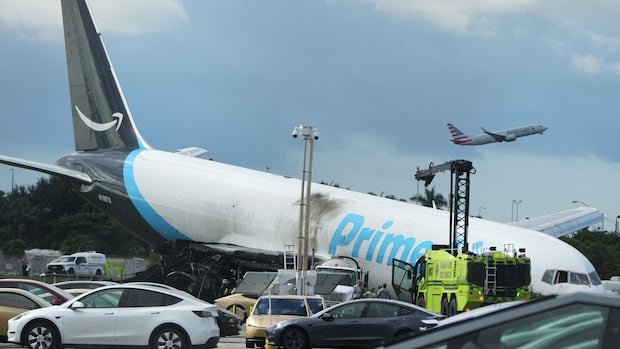
U.S. federal investigators are delving into the circumstances surrounding the Amazon cargo jet incident at Miami International Airport that resulted in the tragic deaths of at least five individuals. Of particular interest is the critical moment during landing, focusing on whether the aircraft touched down too late to come to a safe stop.
Video footage from the landing on Sunday indicates that the Boeing 767 remained airborne along the runway before making contact. Aviation experts suggest that investigators will analyze the exact touchdown point of the plane and question why the pilots did not opt to abort the landing and make another approach if they overshot the normal touchdown zone.
The investigation will also scrutinize factors such as the plane’s speed, braking, weather conditions, wind conditions, mechanical status, and other elements that may have contributed to the fatal runway overrun. The National Transportation Safety Board (NTSB) has dispatched a team led by chair Jennifer Homendy to Miami for an initial briefing on the inquiry.
The cargo jet veered off the runway around 2 p.m. ET after arriving from San Juan, Puerto Rico, crossing a road utilized by warehouse employees and businesses neighboring the airport. The incident claimed the lives of five individuals, with three in critical condition and two others hospitalized with less severe injuries.
The crash led to thick black smoke rising into the air, trapping the pilot, co-pilot, and some occupants in cars, according to Miami-Dade Fire Rescue Chief Ray Jadallah. The responders had to extricate a person trapped under a vehicle, and it remains unclear if the pilots were among the deceased.
Experts highlight that the typical landing zone for an aircraft extends within the initial 914 meters of a runway. If the cargo jet surpassed this area, it should have discontinued the landing and attempted another approach, as noted by aviation safety expert Steve Arroyo.
Former Transportation Department inspector general and pilot, Mary Schiavo, pointed out that online videos show the Amazon plane hovering above the runway for an extended duration without adjusting the nose upwards to bring the main landing gear down.
Weather conditions at the time included dark storm clouds and strong winds, while it was not raining. Schiavo remarked that a tailwind might have contributed to the plane floating further along the runway, complicating the landing process.
Miami International Airport lacks the arresting systems present at over 120 other U.S. airports, designed to safely halt planes that overrun runways. The absence of such systems is due to the airport’s compliance with safety regulations, featuring a 1,000-foot safety buffer at the runway ends, according to FAA’s former director of airport safety and accident investigations, Mike O’Donnell.
The Amazon cargo plane, operated by 21 Air, had a history as a passenger carrier before being converted to a cargo plane in 2015. The NTSB will closely review the maintenance records of the aircraft, particularly given its past foreign ownership.
The airport disruptions following the crash included over 160 cancellations and nearly 325 delays by late Sunday, with flights being diverted to Orlando International Airport. Amazon expressed cooperation with the investigation and conveyed condolences for the lives lost in the tragic incident.
In an unrelated incident last year, a UPS plane crashed at Louisville’s Muhammad Ali International Airport, claiming the lives of all three pilots and 12 individuals on the ground, while injuring twenty-three others.
The incident has prompted a thorough investigation by authorities, shedding light on critical aspects of the landing procedure and potential contributing factors to the tragic outcome.

