
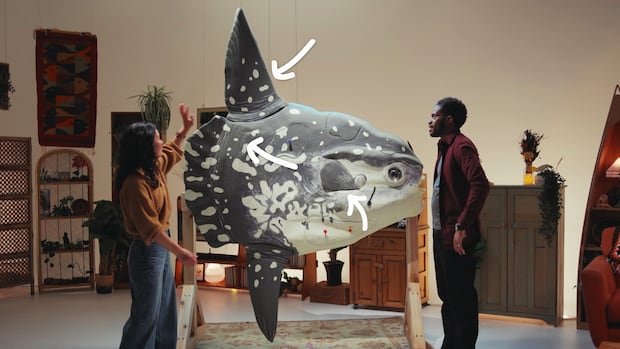
The ocean sunfish, a creature that can reach up to two tonnes in weight and is covered in parasites, including on its eyeballs, might not fit the typical image of a fish. In a recent episode of The Nature of Things 101, host Sarika Cullis-Suzuki delves into the peculiarities of what could be considered the world’s strangest fish.
Describing the unique features of the Mola mola, a type of ocean sunfish and one of the largest fish in the sea, Cullis-Suzuki showcases its distinct characteristics, such as its circular body, lack of a tail, and massive fins, using a life-size model for demonstration.
Despite their ability to travel long distances and dive hundreds of meters deep multiple times a day in search of food, ocean sunfish are susceptible to parasites due to their slow movement, large surface area, and passage through different water zones, as explained by Cullis-Suzuki. These parasites are found all over the fish’s body, including the skin, gills, fins, eyeballs, mouth, and intestine, with scientists having identified 73 different parasite species on the Mola mola and other ocean sunfish types, some of which have parasites themselves.
To combat these parasites, sunfish adopt various strategies, such as breaching out of the water and crashing back down, possibly to dislodge the parasites. They also allow smaller fish and birds to feed on the parasites present on their bodies. Despite the existing knowledge about ocean sunfish, there is still a significant need for further research and study on this species, according to Cullis-Suzuki.
For more insights, viewers can watch The Nature of Things 101 on CBC Gem and The Nature of Things YouTube channel.

