
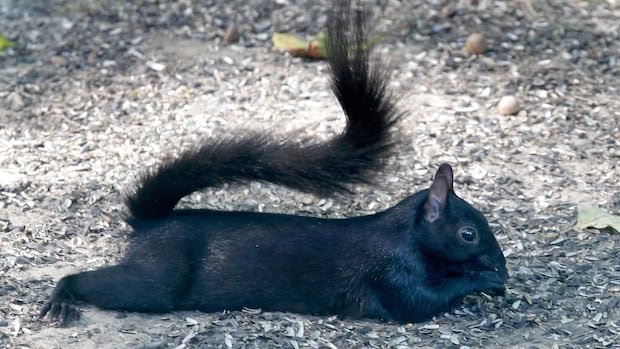
Francis Quang-Hai Dinh spent his initial summer at McGill University exploring Montreal’s parks on his bicycle, on a mission to study squirrels. He meticulously observed and documented over 800 grey and black squirrels in nearly 200 green spaces spanning from Mirabel to Saint-Bruno. What began as a university assignment evolved into a personal endeavor to understand how the city’s geography and waterways influence evolution.
Dinh, who is now pursuing integrative biology at the University of Illinois Urbana-Champaign, relied on his bike due to limited transportation options in suburban areas. His unique approach made him the sole researcher known to conduct manual squirrel surveys park by park across the region.
His research revealed that the prevalence of black squirrels increases as you head north from Montreal. Approximately 12% of squirrels in Montreal are black on average, with percentages rising in northern areas. For instance, north of Laval, up to 40% of squirrels were black, while on the island of Laval, it was around 20%. The study attributed this trend primarily to temperature differences, as black fur absorbs more heat than grey fur.
Furthermore, the study highlighted the impact of forest cover on squirrel coloration, noting that denser tree canopies provide a darker background where black squirrels are better camouflaged.
The research, led by Allison Roth, an assistant professor at the University of Missouri, emphasized using squirrels as a model to study how urban environments drive evolutionary changes. Montreal’s distinct neighborhoods, varying tree cover, and natural boundaries, such as the St. Lawrence River, create nuanced environmental conditions that lead to genetic and physical adaptations within the squirrel population.
Unlike previous studies comparing urban and rural areas broadly, this research focused on neighborhood-specific wildlife changes. It challenged the notion that human development alone drives these transformations, highlighting how urban sprawl, altered temperatures, reduced tree cover, and natural barriers impact wildlife evolution.
The findings, published in a special ecological feature, underscore the importance of understanding how urbanization influences wildlife adaptations. Dinh emphasized that wildlife and cities are interconnected, with animals adapting to persist despite human modifications to their habitats.

