

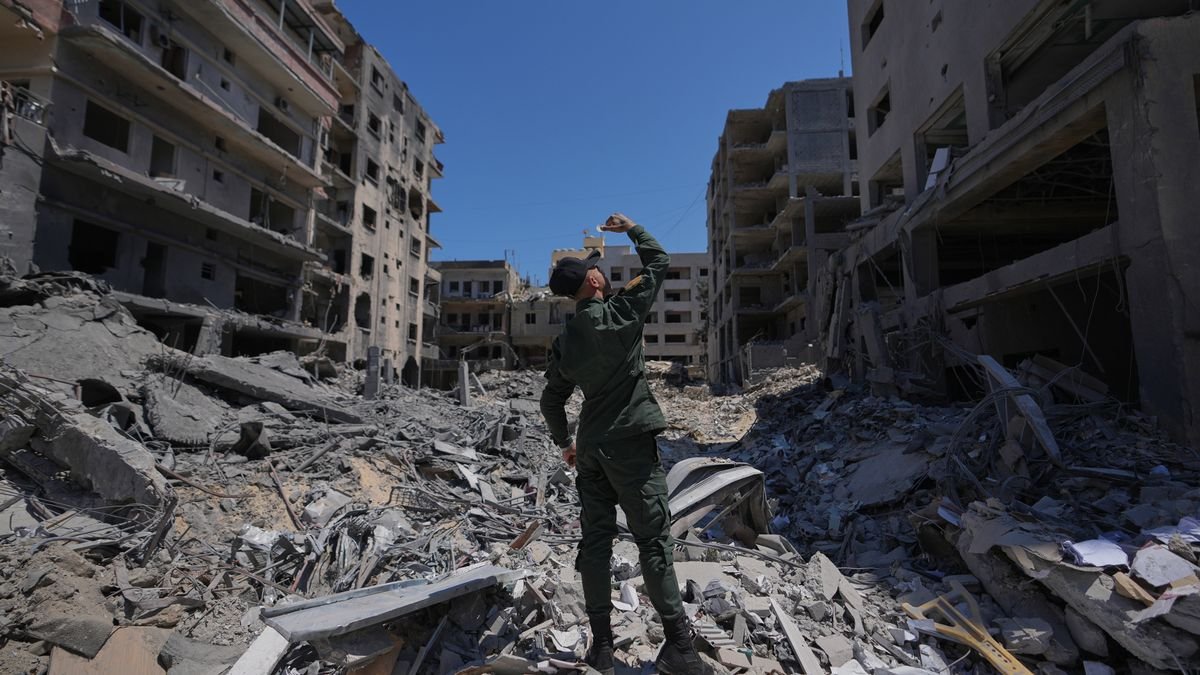
Israel has persisted in striking Hezbollah targets in southern Lebanon despite a ceasefire deal between the US and Iran. One casualty has been reported in the attacks, even though Lebanon was part of the ‘memorandum of understanding’ regarding the Iran conflict. US President Donald Trump’s contentious MOU acknowledges Lebanon’s inclusion, which effectively restricts Israel’s ability to target Iran’s proxy group Hezbollah. This move has sparked outrage among many Israelis who view the MOU as severely limiting their capacity to defend against Hezbollah by preemptively attacking it.
Following the revelation of the MOU details, Israeli delegates reportedly rushed to Washington to strongly advocate for maintaining troops in Lebanon. A Western security source expressed that this development has caused significant strain between Israel and the US, as Israelis perceive it as a surrender. Israel has historically preempted Hezbollah by launching strikes within Lebanon, crippling its potential threat. However, if Israel complies with this agreement, it fears that Hezbollah will strengthen its position.
Israel may find itself at odds with Washington, as it has dedicated efforts to weaken Hezbollah over the years with notable successes. The presence of troops in southern Lebanon is deemed strategically crucial by Israel to safeguard its northern communities. Hezbollah’s leader, Naim Qassem, has praised the Trump MOU as a significant “victory,” while Israeli Prime Minister Benjamin Netanyahu faces the dilemma of defying Washington. Qassem hailed the deal as a triumph for Iran, acknowledging Iran’s role in linking Lebanon to the accord.
Qassem emphasized that the MOU compels Israel to halt its aggression and predicts that Hezbollah will push Israel out of Lebanon. Tehran had consistently pushed for Lebanon’s involvement in any enduring peace deal to resolve the US-Israeli conflict with Iran. Nonetheless, Israel vehemently opposed this notion and was excluded from discussions on the MOU’s content.
The signed MOU by Trump triggers a 60-day consultation period on peace, aiming to reopen the Strait of Hormuz within 30 days despite potential Iranian tariffs on passing ships. However, the agreement defers addressing critical aspects of Iran’s nuclear ambitions and overlooks curbing Iran’s missile arsenal, posing a significant threat to Israel.
The accord’s first point focuses on ending hostilities, including in Lebanon, and the US committing to non-interference in Iran. Within 30 days, the US is required to lift its naval blockade and withdraw from the vicinity of Iran, leading to the reopening of the Strait of Hormuz and lifting of oil sanctions. A $300 billion payment from the US to Iran is mandated, with details on funding remaining unclear. Negotiations will ensue for 60 days on Iran’s nuclear program and further sanctions relief, with Iran pledging not to pursue nuclear weapons.
No new sanctions or reinforcement of US forces in the region are allowed, with a $24 billion payment to Iran, half of which must be delivered before the 60-day period ends. Talks on uranium enrichment will commence only after frozen assets are partially unfrozen, oil sanctions are suspended, and the naval blockade is lifted. Notably, Iran’s missile program and support for proxy groups like Hezbollah are excluded from the agreement.

