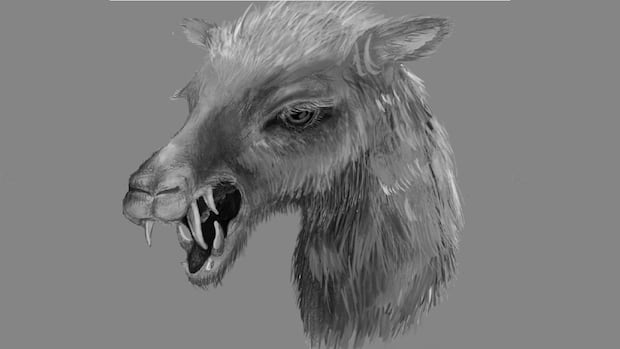
There is no need to be concerned about the vampire camel.
For starters, this fang-bearing animal vanished from the landscapes of what is now North America approximately 12 million years ago.
Furthermore, despite its two pairs of teeth reminiscent of Dracula and its fearsome title, it was likely a plant-eating herbivore rather than a creature that sucked blood.
“Unless you provoked it, it wouldn’t pose any threat,” paleontologist Donald Prothero explained to As It Happens host Nil Kӧksal. “We just felt it deserved an intriguing name.”

Donald Prothero, a paleontologist at California State Polytechnic University, Pomona, discusses Vampyrocamelus, also known as the vampire camel, with host Nil Kӧksal.
Vampyrocamelus is among five newly identified species detailed in an extensive monograph regarding the evolution of camels in North America, published in the New Mexico Museum of Natural History and Science Bulletins.
Researchers indicate that this finding offers fresh insights into the lifestyle during the Clarendonian epoch, a time when massive predators and herds of grazing mammals inhabited the savannah-like grasslands of present-day North America.
What purpose do those teeth serve?
The vampire camel existed between 12 and 13 million years ago in regions that are now Texas, Oklahoma, and Nebraska.
Only male vampire camels were equipped with the prominent, curved fangs that inspired their name.
Despite their sharp front teeth, the molars found in Vampyrocamelus fossils indicate that, similar to all camels, this creature was a herbivore.
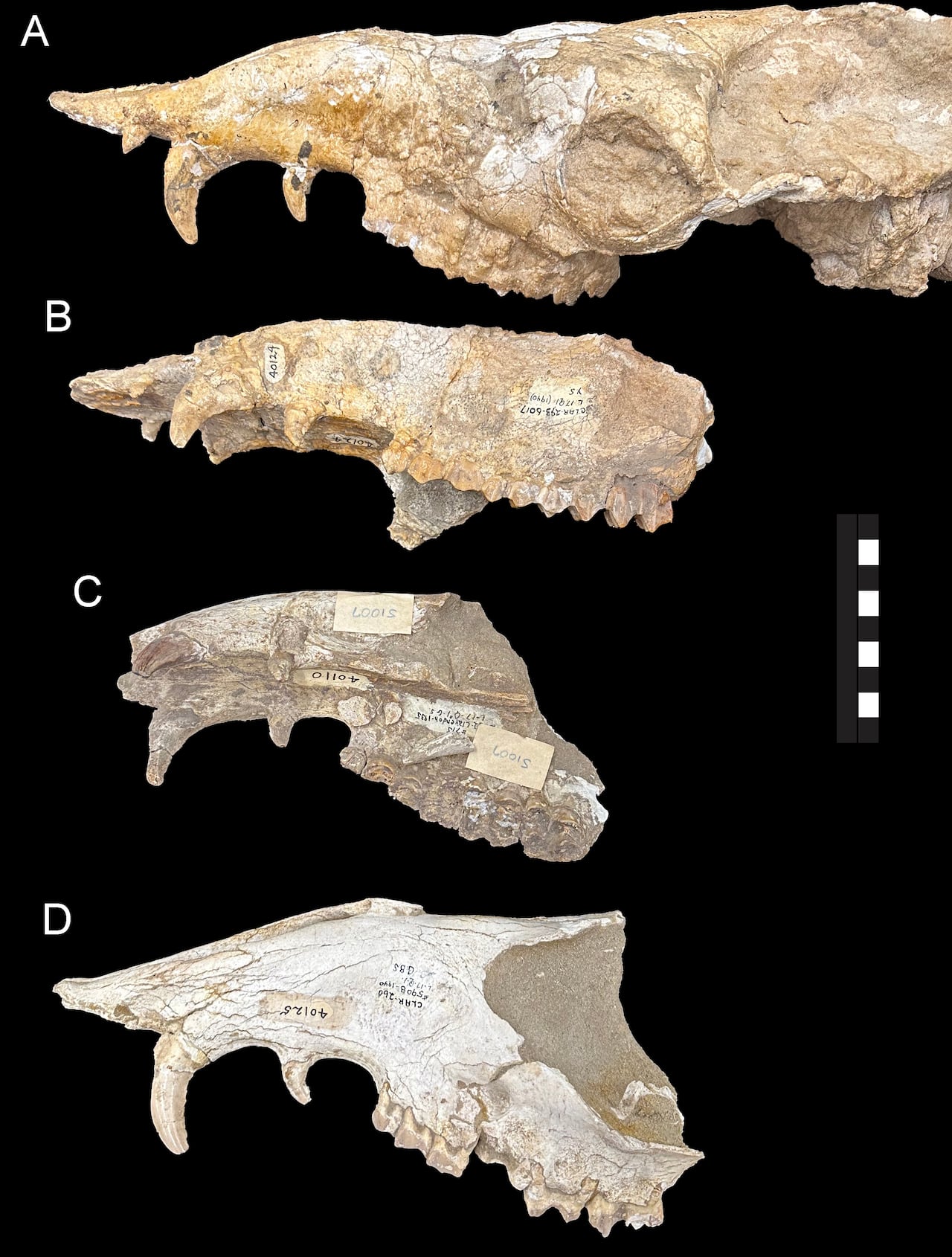
Fossils of Vampyrocamelus show two sets of curved canines. (Donald Prothero)
If those teeth weren’t designed for tearing into unsuspecting prey, what purpose did they serve?
“Male camels utilize their teeth to engage in combat and bite one another until dominance is established, allowing the victor to father the next generation,” Prothero explained, who is also an adjunct professor at California State Polytechnic University, Pomona.
Prothero further noted that it is typical for male camels to possess more pronounced canines compared to females. However, in contemporary species, these teeth are generally more conical and less prominent.
“Modern male camels employ them in battles against each other,” Prothero stated. “And I’ve heard that during these fights, they often aim for each other’s testicles with their sharp teeth.”
Camels in North America?
Currently, camels are found in the deserts of Africa and Asia, as well as in the mountainous regions of South America. However, this was not always the case.
Prothero asserts that camels first appeared in North America approximately 46 million years ago. Since 1982, he has dedicated his efforts to catalog every camel species on the continent.
To achieve this, he and his team of colleagues and students have been studying fossils from the Frick collection, which comprises about 200,000 specimens housed across seven floors at the American Museum of Natural History (AMNH) in New York.
Prothero notes that one entire floor is dedicated to camels, containing 20,000 specimens.
“It’s mostly filled with drawers and drawers of skulls, jaws, and limb bones,” Prothero remarked. “Some of these specimens have been part of the collection for a century without any detailed study.”
-
Meet the ‘hell chicken,’ a feisty little dinosaur who feasted on fruit
-
Newly discovered ancient apex predator had knife-sharp teeth and bone-crushing jaws
This collection was originally owned by millionaire Childs Frick.
Until Frick passed away in 1965, access to his collection was restricted to scientists he employed. It took another ten years before the collection was relocated to New York and became available to researchers.
Prothero and his team examined this collection and classified 80 species of North American camels across 40 genera, including five that are newly recognized by science, such as a long-snouted camel named Longirostrotylopus holroydae.
The researchers also discarded 130 previously classified species that are no longer regarded as valid based on new evolutionary insights.
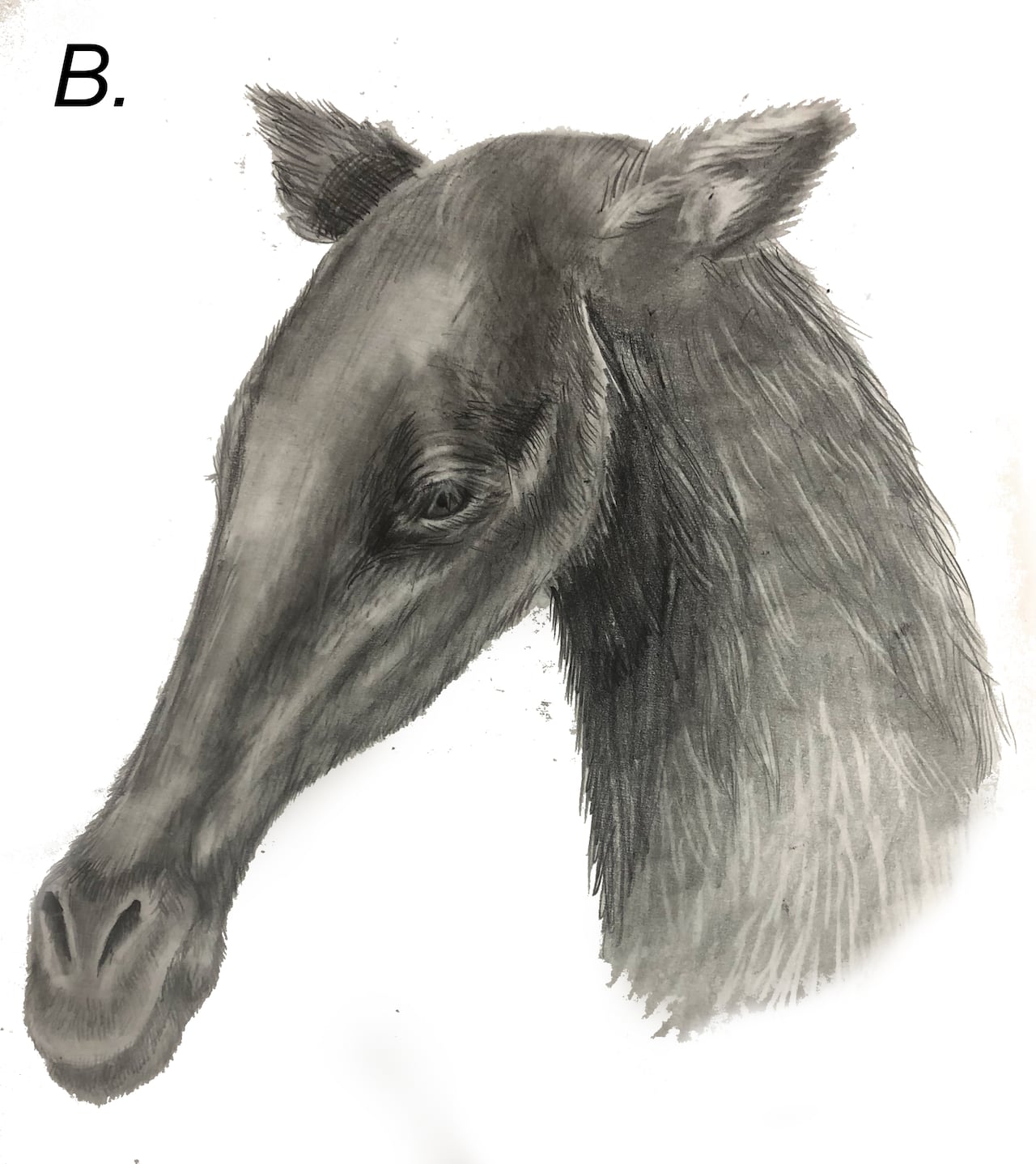
Longirostrotylopus holroydae is a newly defined genus and species of long-snouted camel from the John Day Fossil Beds of Oregon. (Submitted by Donald Prothero)
Danielle Fraser, a paleobiologist at the Canadian Museum of Nature, welcomed the new taxonomy, which includes the vampire camel.
“Understanding how many species existed is crucial to revealing the true patterns of evolutionary change,” Fraser, who did not participate in the research, stated in an email.
“This monograph could enhance fossil databases utilized by numerous scientists to comprehend how mammalian faunas have evolved over time.”