A recent study commissioned by the organization advocating for Eastern Canada’s proposed high-speed rail initiative outlines the potential advantages this project could bring to individuals, communities, and the national economy if executed properly.
The report emphasizes that Alto will justify the significant investment due to its ability to enhance productivity by improving connections for individuals living and working within the Toronto-Quebec City corridor.
The initiative was unveiled late last year, featuring proposed stops in Trois-Rivières, Laval, Montreal, Ottawa, and Peterborough. The CEO mentioned this summer that some trains may include a stop in Kingston.
The most recent cost projection from the government estimates the total expenses to be between $60 billion and $90 billion, with the federal budget analyst recently stating this figure could escalate by an additional $15 billion to $25 billion. Construction is anticipated to commence at the end of this decade or the beginning of the next.
According to the analysis conducted by Quebec consulting firm Aviseo, once fully operational, Alto is expected to produce approximately $24.5 billion in financial benefits each year by linking the major population centers of Ontario and Quebec.
The report suggests that workers would gain improved access to job opportunities, and employers would be able to tap into a broader talent pool if commuting between Ottawa or Trois-Rivières and Montreal, or Peterborough and Toronto, takes an hour or less.
Reduced travel time translates to increased opportunities for in-person learning, collaboration, and networking, along with additional leisure time for employees.
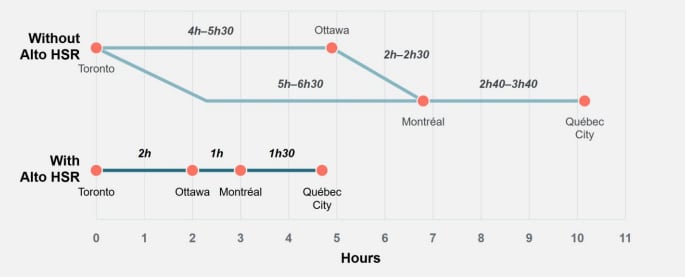
Aviseo’s 2026 study contrasts driving times between significant population centers along the suggested route, above, with the travel time on an Alto train, below. (Aviseo)
This increase in productivity is expected to attract investment and alleviate the economic burden of an aging population.
“When employees and companies generate more value per hour, wages can increase, prices may decrease, and governments can enhance revenue without raising tax rates,” the report notes.
‘Cost of inaction’
Aviseo suggests that the expanding communities along the proposed rail route will be required to invest around $50 billion in roads, airports, and rail systems in the absence of Alto, without achieving faster travel between these areas.
“There is a cost associated with inaction,” stated Jean-Pierre Lessard, co-founder and partner at Aviseo.
-
Alto high-speed rail project could cost more than originally thought: budget watchdog
-
Montreal-Ottawa high-speed rail line could cross 1,700 properties, Alto predicts
The corridor connecting Toronto and Quebec City accommodates 40 percent of Canada’s population and gross domestic product, yet it still lacks “a dependable, swift, frequent, and affordable means of travel,” as stated in the report.
The projected reduction in private vehicle usage due to Alto—approximately 6.8 million fewer trips by 2055, according to Aviseo—would also lead to decreased congestion and accidents.
Additionally, Alto is expected to enhance tourism in areas close to its stations, as indicated by the report.
Strong opposition
There has been significant opposition to the initiative, with some expressing concerns about substantial disruption and the potential for private land expropriation, with minimal advantages for certain regions.
Quebec‘s premier and the federal Conservative Party have voiced opposition to the project, while a source informed CBC News in July that the Ontario government is reconsidering its backing of Alto.
-
Could Quebec’s new government derail plans for Alto’s high-speed train project?
-
Quebec farmers challenge costs of Alto high-speed rail, propose new — slower — plan
The Aviseo study, released shortly after a farmer-supported analysis of a less expensive, slower train option, promises local advantages including a share of the estimated 5,000 jobs associated with the operation and maintenance of Alto.
This economic impact could reach up to 110 kilometers from “station cities,” as reported.
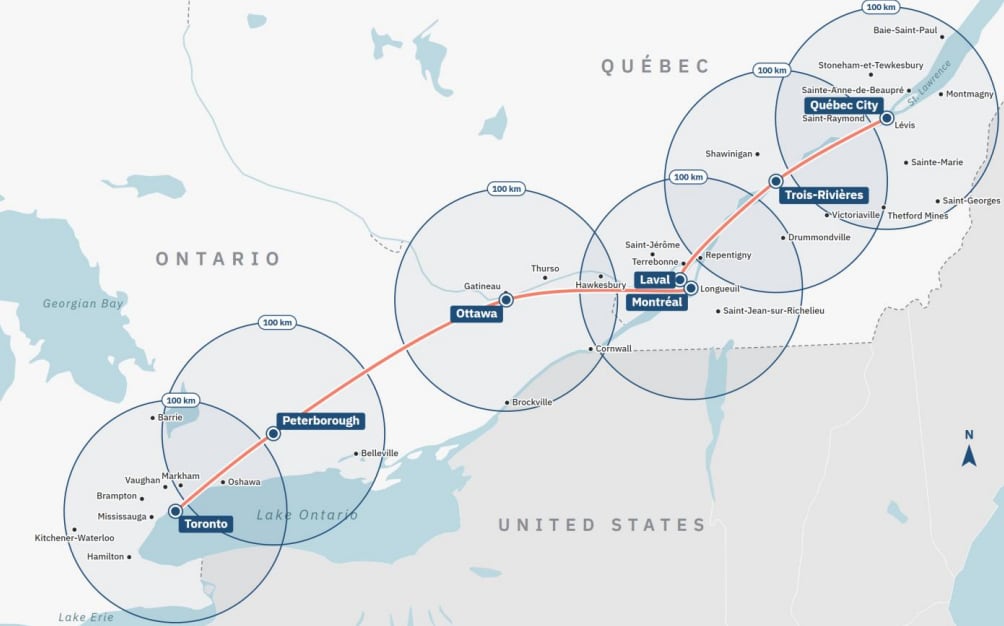
Aviseo indicated that its research on other rail projects shows economic benefits can extend as far as 110 kilometers from a station. This study did not account for a stop in Kingston, Ont. (Aviseo)
A representative from Alto recently informed CBC News that they intend to reveal a more defined proposed corridor between Ottawa and Montreal in the upcoming weeks.
The Crown corporation also plans to release a business case early next year.