

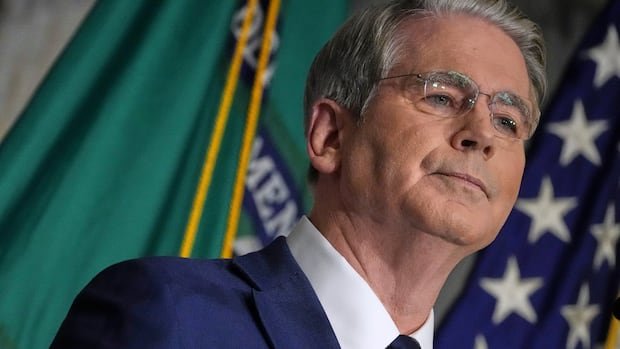
The Trump administration revealed an expansion of sanctions that could be imposed on entities and nations engaging in business with Iran, intensifying economic pressure on Tehran as the conflict reaches its six-month milestone. Treasury Secretary Scott Bessent, during a press briefing, introduced what he labeled as an “economic D-Day” to prompt countries to cut off business relations with Iran or face potential exclusion from the dollar-based financial system for key companies and entities.
Bessent stated, “We are initiating an economic offensive against Iran’s financial networks worldwide. Our goal is to sever all economic support sustaining this authoritarian regime until Tehran stands isolated.”
The U.S. Treasury Department disclosed that it has identified the networks, facilitators, and financial channels utilized by Iran to smuggle oil and evade sanctions, indicating collaboration with U.S. allies to target any sources of Iran’s “illicit income.” Sanctions have been imposed on nearly 60 entities, individuals, and vessels across various sectors including digital assets, technology, gold, aviation, and shipping, which the Iranian government utilizes to bolster its economy.
China has been a significant purchaser of Iranian oil for years, prompting increased U.S. efforts to restrict Chinese acquisitions without yet targeting major Chinese banks that may be aiding the trade.
Iran issued warnings of potential military retaliation and further reductions in Gulf oil exports in response to anticipated U.S. economic actions. Iranian Finance and Economic Affairs Minister Ali Madanizadeh affirmed readiness for U.S. sanctions, stating, “We are fully prepared for the U.S. sanctions.”
Brig-Gen. Hossein Mohebbi, a spokesperson for Iran’s Islamic Revolutionary Guard Corps (IRGC), pledged severe repercussions on U.S. vital interests and energy routes if Iran’s infrastructure is endangered.
As the conflict between the U.S. and Iran approaches six months, global energy prices have surged. Although combat has lessened, diplomatic efforts to resolve the conflict have stalled, and energy prices remain high due to continued blockades in the Strait of Hormuz.
President Trump’s approval ratings have declined, with only 33% of Americans approving of his performance in the latest Reuters/Ipsos poll. Trump argues that the economic consequences are necessary to prevent Iran from acquiring nuclear weapons.
Sanctions against Iran have been in place for years, focusing on limiting oil revenues, targeting aviation and cryptocurrency activities, restricting weapon components procurement, and disrupting funding for IRGC-affiliated businesses, a significant player in Iran’s economy.
Despite sanctions barring designated entities from the dollar-based financial system, Iran has managed to swiftly establish new front companies and vessel registrations to evade these restrictions.

