
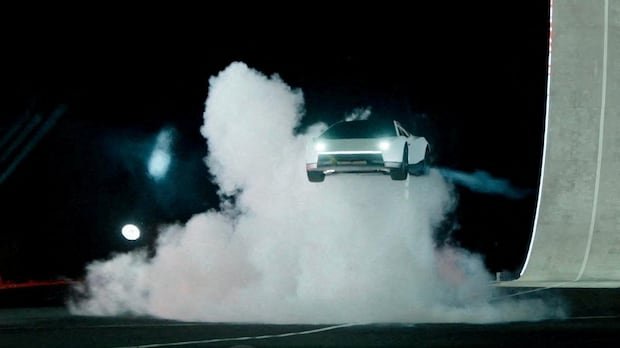
Tesla introduced a revamped Roadster featuring rocket-style thrusters on Thursday, announcing plans for production to commence in 2028, over a decade after revealing a new iteration of its electric sports car. The sleek white two-seater vehicle, a result of collaboration with Elon Musk’s SpaceX, showcased its unique capabilities by driving upside down on a ramp with a suction system, executing mid-air maneuvers, and landing using built-in thrusters. At the event, it even demonstrated the ability to jump over a truck and other vehicles, showcasing its innovative design.
Some observers interpreted the collaboration as a strategic move by Musk to generate interest in a potential merger between his two major companies. The unveiling generated excitement among investors, with Tesla shares rising by five percent in pre-market trading the following day. While the Roadster reveal signifies a highlight for Tesla after previous delays, the company is shifting its focus towards self-driving technology and robotics, with upcoming third-quarter results holding significant importance for investors.
Described as an “engineering flex” by Gene Munster, managing partner at Deepwater Asset Management, the Roadster event was seen as a spectacle rather than a significant financial driver for Tesla. Despite Musk downplaying the car’s financial impact, it holds symbolic value as Tesla’s new flagship model, according to Morningstar analyst Seth Goldstein. The event garnered praise from viewers and investors for its impressive presentation and cutting-edge technology.
During the event, Musk and other executives refrained from disclosing specific pricing details, although Tesla previously mentioned a base price of $200,000 US for the Roadster. Reservations for the vehicle post-event indicated varying deposit requirements based on different versions, with the “Performance” model requiring a $50,000 US deposit and the advanced “Thrust” model necessitating a $250,000 US deposit. A exclusive “Rocket” variant, labeled as “invite only,” offers a unique single-seat design with a “full flight system.”
The Roadster’s exceptional performance capabilities were highlighted, with Tesla’s vehicle engineering chief Lars Moravy stating it can accelerate from zero to 97 km/h in under a second and reach a top speed exceeding 370 km/h. Musk expressed enthusiasm for the car’s speed, emphasizing its remarkable acceleration capabilities. Despite falling short of previous promises, the Roadster boasts an impressive range of over 480 kilometers on a single charge.
Originally released in 2008, the first Roadster marked Tesla’s entry into the electric vehicle market and revolutionized perceptions of EVs. The unveiling of the next-generation Roadster coincides with Tesla’s strategic shift towards AI-driven self-driving technology and robotics, with recent initiatives including the discontinuation of certain vehicle models to prioritize production of humanoid robots and the launch of a driverless robotaxi named Cybercab.
As Tesla prepares to announce its third-quarter results on October 21, analysts suggest that the company’s financial performance and cash flow metrics will hold greater significance for investors than the Roadster reveal. Despite a decline in sales of Tesla’s existing EV lineup over the past years, the company witnessed a boost in deliveries during the third quarter of 2026, attributed in part to rising gas prices.

