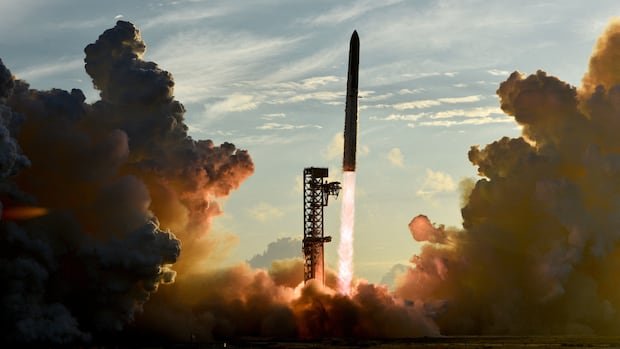
SpaceX successfully launched its Starship into orbit for the first time on Monday, deploying advanced Starlink satellites before cutting short the mission and landing in the Pacific Ocean after three hours. Originally planned for a 10-hour flight encompassing six orbits around Earth to demonstrate readiness for NASA’s Artemis moon program, the spacecraft encountered an issue with one engine shutting down prematurely. However, with the remaining systems operational and the faulty engine no longer necessary, flight controllers opted to proceed as scheduled.
Elon Musk’s revolutionary Starship rocket carried 26 new-generation Starlink satellites, adding to the existing 11,000 units providing internet services. The deployment of the satellites from the spacecraft was met with enthusiasm from onlookers at the launch site in Starbase, Texas.
Following the successful orbit achievement, SpaceX decided to end the flight earlier than planned without providing a specific reason. This marked Starship’s 14th full-scale launch from Texas in three years, a significant milestone for the company’s space exploration endeavors.
While the Starship achieved the desired orbit at a speed of 28,000 km/h, flight controllers chose to err on the side of caution and brought it back after a few laps instead of completing the full intended mission. The first-stage booster was intentionally directed to the Gulf of Mexico rather than returning to the launch site, emphasizing SpaceX’s commitment to safety measures.
SpaceX is keen on certifying Starship for orbital flights as a crucial step towards future missions to the moon and Mars. With plans for potential spacecraft recovery methods and a focus on reusability to reduce launch costs, SpaceX is at the forefront of innovation in space exploration.
The company’s ambitious goals include upcoming missions such as NASA’s Artemis III and IV, aiming to conduct orbital docking exercises and lunar landings with the involvement of multiple spacecraft. While Musk’s original vision for Starship involved Mars colonization, the current focus is on lunar missions and satellite launches, signaling a shift in SpaceX’s space exploration priorities.