

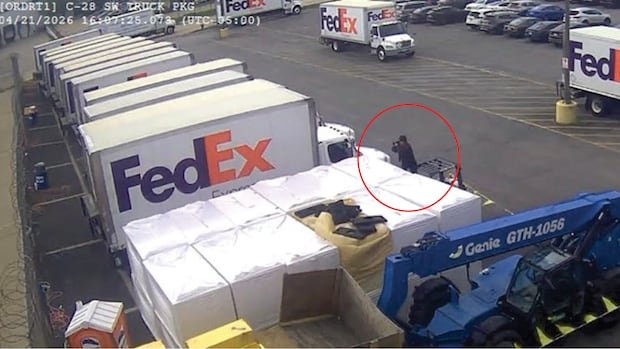
An Ontario university student is under investigation for suspected espionage following his admission to the FBI that he accessed airport facilities in Toronto and Chicago to capture images on behalf of an unidentified individual from China.
Weiheng Zeng, a Chinese national, was apprehended in Michigan on August 23 after crossing the Ambassador Bridge from Windsor, Ontario. He faces a charge of making false statements and appeared in a federal court in Detroit, where he agreed to remain in custody pending his trial.
Zeng, a University of Waterloo undergraduate student born in 2004, drew the attention of U.S. authorities in April following an incident captured on security footage at Chicago’s O’Hare International Airport. The complaint detailed how Zeng was observed taking photos, climbing a forklift, and attempting to access locked delivery trucks and shipping containers in the airport’s parking lot.
The investigation linked Zeng to a dark blue Chrysler Town & Country minivan with Ontario license plates captured on nearby CCTV footage. When he tried to re-enter the U.S. last month in the same vehicle, Zeng informed U.S. Customs and Border Protection that he was on a one-day trip to Chicago but was subjected to multiple interviews due to inconsistencies in his statements.
Upon discovering numerous photos of military aircraft on his phone, Zeng initially claimed they were for a flight radar website, citing plane photography as a hobby. However, further examination of his phone revealed images of individuals in tactical gear holding rifle-styled firearms, which Zeng asserted were related to airsoft guns and denied any military background.
Zeng eventually confessed that he was being compensated by a “Chinese contact” to photograph specific aircraft and their tail numbers, believing the individual to be affiliated with a Chinese security service. He disclosed a complex communication method, wherein the contact sent him new SIM cards every few months for use in his Huawei cell phone, instructing him to destroy the cards and delete conversations and images after use.
Furthermore, Zeng disclosed that he was directed by his contact to photograph inside a FedEx facility at Toronto Pearson International Airport in October 2025, where he managed to capture exterior images only. He acknowledged receiving payment for these activities.
During court proceedings, a federal prosecutor argued that Zeng posed a flight risk due to being a foreign national with potential ties to espionage-related activities. Zeng agreed to remain in custody during a subsequent hearing, confirming his understanding through a Mandarin-language interpreter.
While the allegations against Zeng remain unproven in court, details about his academic program and entry into Canada are unclear. The University of Waterloo declined to comment on the ongoing legal matter, and local authorities confirmed no involvement in the investigation. Requests for comment from the Chinese embassies in Ottawa and Washington went unanswered.
For news tips related to this story, reach out to CBC News senior reporter Thomas Daigle at thomas.daigle@cbc.ca.

