

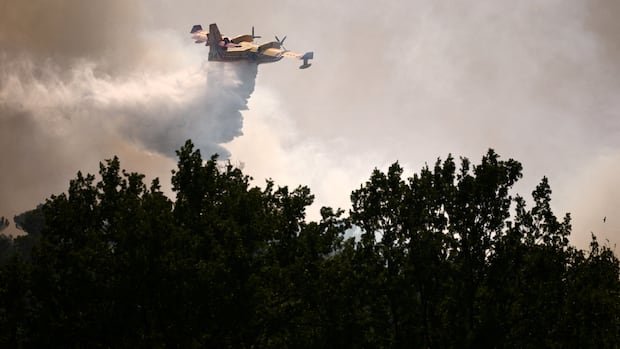
As France grappled with what President Emmanuel Macron described as its most severe wildfire crisis since the Second World War, criticism swiftly emerged over the government’s readiness for the extensive fires. However, attention soon turned to an unexpected target: Canada.
Didou Deyres, the vice-president of the forest fire defense department in Le Porge, where 183 residences were destroyed in late July following a blaze in the pine forests near Bordeaux, highlighted the inadequacy of Canadairs. France possesses 12 of these distinctive yellow water bombers, but Deyres revealed that only seven were operational during the peak of the crisis. He expressed that having more firefighting resources available earlier, both on the ground and in the air, could have altered the outcome.
In a somewhat jesting tone, Deyres jokingly pointed fingers at Canada, emphasizing the need for collaboration to enhance the aircraft. The surge in demand for Canadian-manufactured water bombers across Europe is outpacing the production capacity of De Havilland Canada, the manufacturer.
The continent’s recent droughts and successive heatwaves have fueled devastating fires, intensifying the pressure on governments to expand their aerial firefighting fleets. European nations have placed orders for 22 new Canadair 515 aircraft from De Havilland Canada since 2022. Yet, due to a prolonged hiatus in aircraft production, the first newly constructed planes are not anticipated to reach European buyers until 2028. France, for instance, is slated to receive the second half of its four-plane order by 2032.
The Canadair planes, renowned for their longevity and operational efficiency, possess unparalleled capabilities in the firefighting aircraft market. They can swiftly scoop around 6,000 liters of water in approximately 12 seconds, making them a crucial asset in battling wildfires.
Neil Sweeney, the vice-president of operations at De Havilland Canada, emphasized the significance of these aircraft in European firefighting operations. The reestablishment of the Canadair line by De Havilland in 2022 faced challenges due to the dismantling of the supply chain, necessitating a meticulous sourcing process for the multitude of specialized parts required for each aircraft.
France’s existing fleet of Canadairs has been under strain, with aircraft being utilized almost continuously during peak fire seasons, leading to heightened maintenance demands. The necessity for modernizing and streamlining production processes has been underscored by experts to meet the escalating demand for these critical firefighting assets.

