

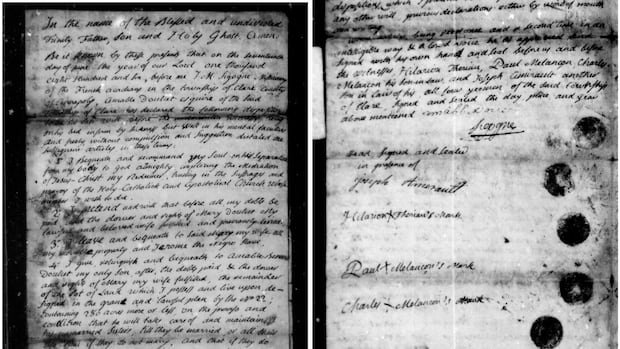
Hilarion Thériault, a 71-year-old Acadian in the 19th century, defied the norm by creating a will, a rare act among Acadians of that era due to the scarcity of property resulting from the Acadian deportation. Post-deportation, many Acadians lost their homes and land, compounded by the legal restriction on Roman Catholics from owning property until the 1780s. Despite these challenges, Thériault, in his will, emphasized the importance of being prepared for death.
Colby Gaudet, a post-doctoral fellow at Dalhousie University, delved into the study of Thériault’s will and 23 others from Clare, N.S., shedding light on how families navigated legal and religious customs in times of grief and death. Gaudet highlighted the dual nature of resistance and compliance exhibited by Acadians, using existing Anglophone property models while asserting their Roman Catholic identity.
Thériault’s will included provisions for debt settlement, reparations for any wrongdoings, and ensuring peace for his family. Maurice Basque, a historian at l’Institut d’études acadiennes at the Université de Moncton, contextualized these wills within the backdrop of significant social ostracization of Acadians post-deportation.
The Acadian expulsion in 1755 by Lt.-Gov. Charles Lawrence led to the transfer of Acadian lands to the Crown, which aimed to replace the Acadian populace with settlers from New England. Some Acadians eventually returned, only to face continued marginalization through oath tests that barred them from key positions of power.
Gaudet emphasized the language barrier faced by Acadians in Clare, where all county judges overseeing wills were Anglo-Protestant, making it challenging for Acadians to draft wills in a language they were not fluent in. These wills, authored by the priest Jean-Mandé Sigogne, acted as a bridge between the Acadian families and the judiciary system.
The wills examined by Gaudet belonged mostly to community leaders like Thériault, who played significant roles in the parish. Given the integral role of the church and Catholicism in their lives, these leaders ensured their wills reflected their faith, incorporating Catholic details that set them apart from Protestant wills of the time.
Furthermore, the study of these wills unveiled insights into the relationships between Black individuals and Acadians. For instance, the will of Amable Doucet bequeathed a Black slave named Jerome to his wife, shedding light on the complex dynamics within the community.
The exploration of historical documents like these wills provides valuable perspectives on the challenges and resilience of Acadians in navigating legal, societal, and religious norms during tumultuous times.
[End of rewritten article]