

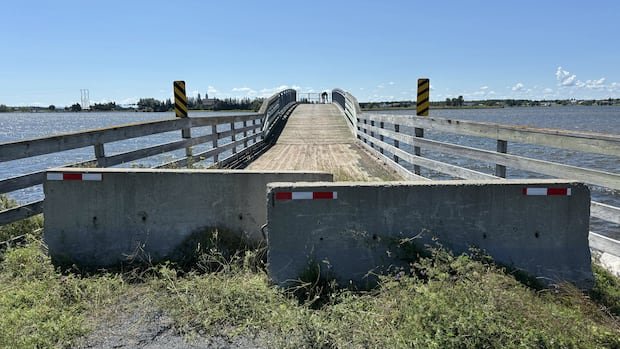
Nearly a decade following the destructive fire that severed a vital link in the recreational trail system of the Acadian Peninsula, plans are underway to reconstruct the Inkerman bridge. A substantial sum of $12 million has been allocated for this endeavor, with the federal government and the Acadian Peninsula Regional Service Commission jointly providing the funding. The federal contribution amounts to $11 million, while the regional service commission is adding an additional $1 million. At present, the province has not committed any funds towards the project.
The Inkerman bridge, spanning almost 500 meters over Inkerman Lake and connecting Tracadie and Shippigan, served as a crucial route for pedestrians, cyclists, snowmobilers, and ATV enthusiasts. Its destruction in a fire in 2017 not only physically divided the region but also led to a sense of community loss. Danielle Savoie, chair of the board for the Véloroute Péninsule Acadienne, expressed the impact by stating, “It was devastating because it cut the Véloroute in half.”
The Véloroute encompasses over 600 kilometers of trails linking coastal communities from Neguac to Lamèque and Rivière-du-Nord. A significant portion of the trail, about 70 kilometers, was paved in 2018, facilitating connectivity between multiple municipalities and businesses. Since the bridge was destroyed, residents have been compelled to detour onto Highway 113, the main thoroughfare in Inkerman, raising concerns about road safety.
The long-awaited announcement of the $12 million funding for the Inkerman bridge reconstruction was made by Serge Cormier, the member of Parliament for the area, during a gathering of approximately 300 residents in Inkerman. Cormier expressed relief at the culmination of years of effort, acknowledging the emotional significance of the moment for the local community.
A portion of the reconstruction funding is expected to come from a local group known as the bridge committee, which has raised around $5 million through initiatives like Chase the Ace lotteries since 2017. While some of these funds were utilized to develop new trails, a substantial amount remains in the committee’s reserves. Despite years of stagnation, the project gained momentum when a funding request was finally submitted to the federal government last year.
Although the Inkerman bridge is owned by the province, it is yet to confirm its financial commitment to the rebuild. Isabelle Thériault, the province’s tourism minister, emphasized the dedication of local MLAs to the project but highlighted the necessity for further discussions and planning before any funding commitments are made. Gilles Lepage, the minister responsible for the Regional Development Corporation, reiterated the province’s commitment to collaborating with partners on advancing projects in the region.
Serge Cormier disclosed that the estimated cost of the bridge stood at $18 million during the last assessment in 2025. With $12 million secured from the federal government and the regional service commission, Cormier expressed confidence in the province providing the remaining $6 million. The rebuild will feature a new 500-meter bridge constructed from a material other than wood to avert a repeat of the 2017 fire incident.
The trail, catering to approximately 174,000 users annually, is anticipated to further boost the cycling tourism economy in northern New Brunswick. While construction timelines were not specified, Cormier emphasized the importance of involving local companies in the project bid process. He underscored the need to support regional businesses and acknowledged the significance of projects like these in fostering economic growth and community development.

