
WARNING: This article contains information about sexual assaults on minors.
During the ongoing trial at the Ontario Superior Court of Justice in Brampton, new details emerged this week regarding a cold case spanning over three decades. Richard Neil, 67, has pleaded not guilty to 17 charges, including kidnapping, sexual assault causing bodily harm, and administering a stupefying drug.
The case dates back to the early 1990s when an unidentified individual severely restrained and sexually assaulted three children aged eight and younger in parks across southern Ontario between 1992 and 1995. Recent revelations from prosecutors suggest that DNA evidence connects Neil to each of these attacks.
The assaults occurred in Kitchener, Brampton, and Oakville.
This week’s proceedings focused on items that the prosecution alleges are linked to Neil, including underwear with holes cut out and used as a mask by the perpetrator.
Margaret Henry, a forensic scientist at the Centre of Forensic Sciences, testified that semen matching Neil’s genetic material was found on the underwear.
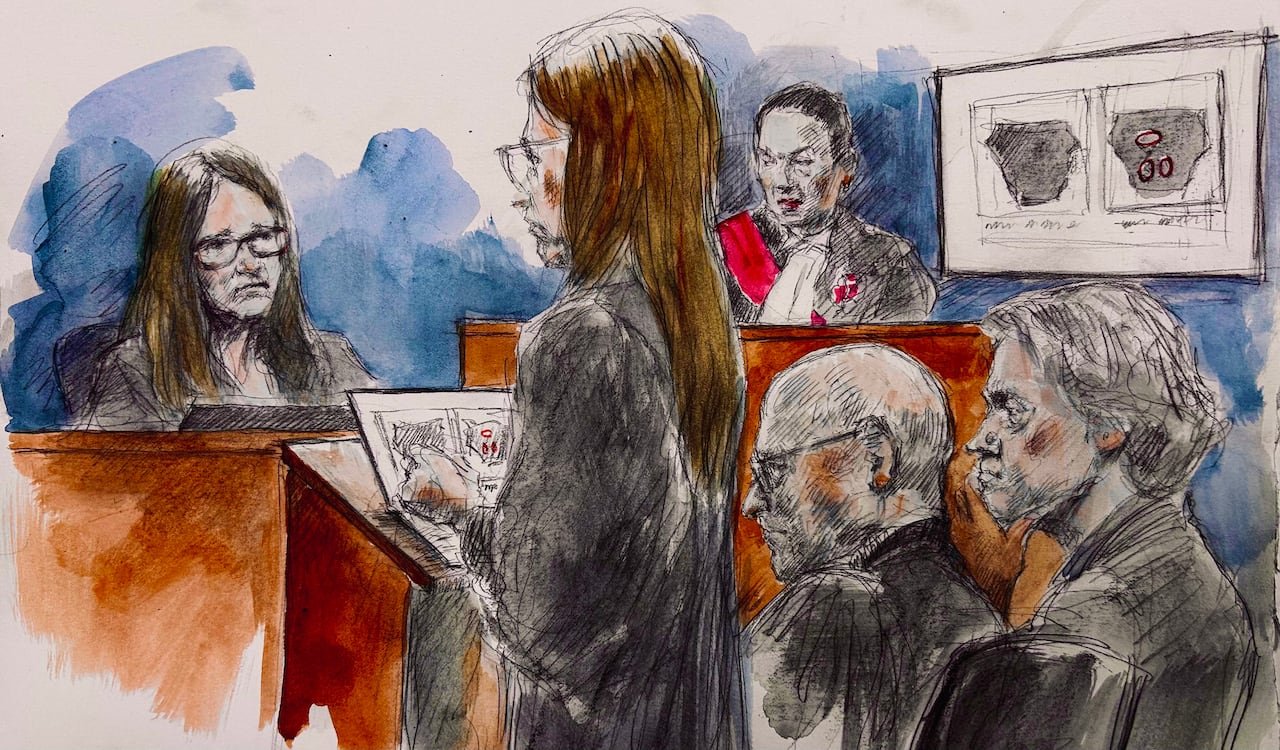
Forensic scientist Margaret Henry testifies while a courtroom monitor shows underwear, a piece of evidence in the trial of Richard Neil, on October 15, 2026. (Pam Davies/CBC)
She also explained the use of a mathematical formula in DNA testing to exclude individuals from being associated with crime scene DNA.
“This number provides very strong support for the proposition that Richard Neil is the source for those DNA profiles rather than an unknown, unrelated person,” Henry stated during her testimony.
Henry further elaborated that after evaluating approximately 310 persons of interest over the years, Neil was eventually linked to the assaults.
Technological Advancements in DNA Analysis Drive Case Progress
Henry noted significant advancements in DNA testing since the cases were initially linked in 1995. The Centre of Forensic Sciences, where Henry has worked since the late 1990s, first compared Neil’s DNA with various crime scene samples in 2024.
Recently, the jury discovered that investigators identified Neil as a suspect through genetic genealogy analysis conducted in the U.S., a technique not available during the initial investigation in the 1990s.

