

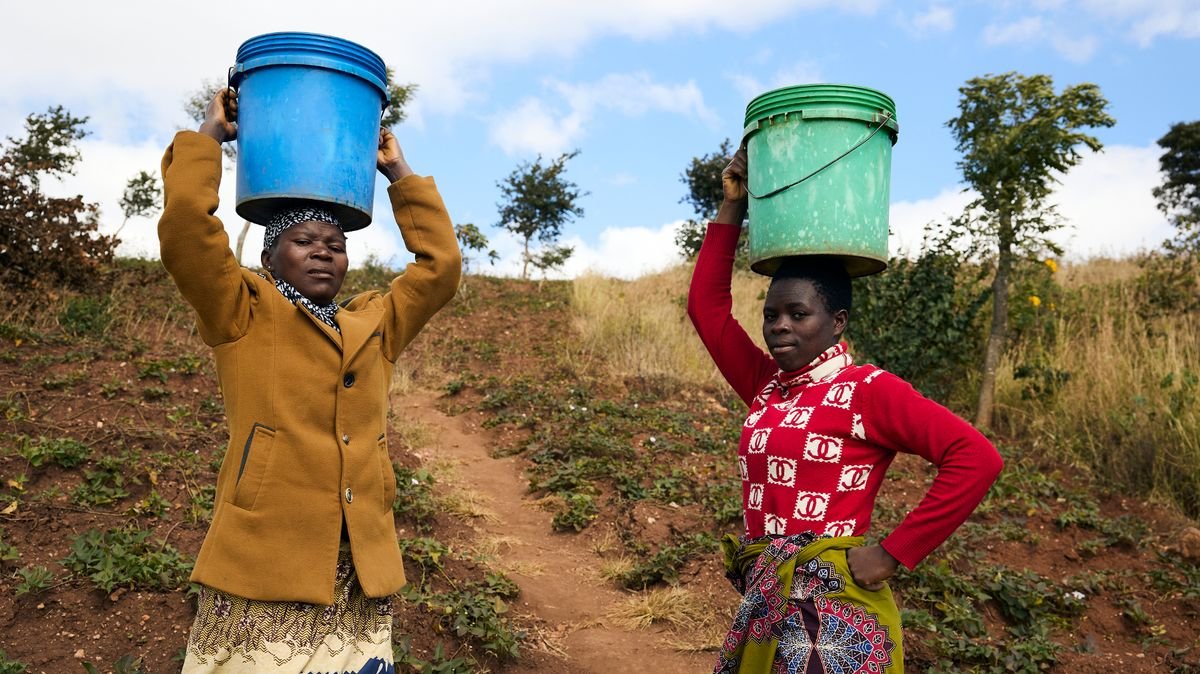
Every day at 3am, Dina Njati embarks on an arduous eight-hour journey to secure water for her family. The 37-year-old descends a steep hillside to fill a 20-liter container from a small, muddy pond, carrying it back home on her head. This routine is a crucial part of her daily struggle.
Dina’s village, Mkambabisi in Malawi, relies on a single water source that is often contaminated, leading to sickness for both Dina and her daughter. Despite the health risks, they continue using the water due to limited alternatives.
Unfortunately, Dina’s experience is not uncommon in Malawi, where one in three people lacks access to clean water and over half the population lacks proper sanitation facilities. However, there is hope on the horizon as a new borehole, funded by the Wimbledon Foundation and implemented by WaterAid, is set to transform life in Dina’s village by providing clean water nearby.
This new development will not only ease the burden of water collection for Dina but also enable her to resume her carpentry career, which she had to put on hold to care for her grandfather. The prospect of a better future drives Dina, who hopes her daughter won’t have to endure the same hardships she faces daily.
The impact of clean water extends beyond health, as seen in the stories of individuals like Eliza Brutula and Trinity Mbewe, who had contrasting childbirth experiences due to access to clean water. Clean water not only improves health outcomes but also opens doors to better education and economic opportunities.
WaterAid’s efforts in Malawi aim to address the critical issue of water scarcity that affects communities and individuals on multiple levels. The transformation brought by clean water is not just about convenience; it is about empowering individuals to shape their own futures and communities. The value of clean water cannot be overstated, as it lays the foundation for a healthier, more prosperous society.

