
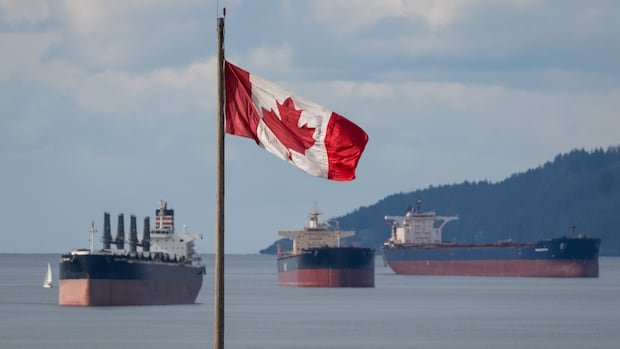
Canadian exports to China surged by 30% in the initial half of 2026, marking a 3.6% overall increase in trade compared to the previous year, as per a study conducted by Statistics Canada. The data, detailed in a recent report by the Canada China Business Council and the University of Alberta’s China Institute, mirrors the renewed engagement between the two nations. This development aligns with Canada’s strategic efforts to diversify its economic portfolio amidst strained relations with the U.S.
During the first half of 2026, consumer goods trade between Canada and China reached $66.6 billion, reflecting a 3.6% rise, with exports soaring by 30% to $21.74 billion annually. Notably, energy and minerals dominated the export landscape, constituting 58.4% of all domestic exports to China during this period. Energy exports, including crude oil and liquefied propane, witnessed an impressive 81.8% growth, while metal ores and non-metallic mineral exports surged by 29%, encompassing copper ore shipments.
Bijan Ahmadi, the Executive Director of the Canada China Business Council, expressed, “This marks a record high for our first-half exports to China.” Despite historical trade ties, the substantial increase in exports is believed to be influenced by a convergence of factors.
The diplomatic and economic relations between Canada and China have been thawing following years of tension, primarily stemming from the arrest of Huawei executive Meng Wanzhou in 2018. Concurrently, amid escalating trade conflicts with the U.S., Prime Minister Mark Carney has reiterated Canada’s commitment to forging new trade agreements with global partners to lessen dependence on the U.S.
The Trans Mountain Pipeline reaching 97% capacity in June has significantly enhanced Asia’s access to Western Canadian crude oil. Furthermore, disruptions in oil shipments due to the U.S.-Israeli conflict with Iran in the vital Strait of Hormuz have boosted oil prices, prompting customers to turn to alternative suppliers like Canada.
Anton Malkin, the Head of Research at the University of Alberta’s China Institute, highlighted the complementarity in trade relations between Canada and China despite prevailing tensions. Forecasts indicate that by 2028, Asia may account for 70% of Canada’s oil exports, further underlining the evolving trade dynamics.
The trade dynamics witnessed in the first half of 2026 indicate a substantial shift in bilateral relations between Canada and China. Agreements struck between Carney and Chinese President Xi Jinping have facilitated the entry of Chinese electric vehicles into the Canadian market, leading to a surge in Canadian agricultural exports in exchange for reduced tariffs.
Alberta and British Columbia have notably recorded significant export gains across energy, minerals, forestry, and agriculture sectors. Despite the overall trade escalation, import numbers have seen a 5.8% decline year over year, with Ontario experiencing the largest import drop. The report authors noted modest agricultural improvement, with varied performance across different commodities.
Looking ahead, the emphasis is on diversifying trade partners and strengthening domestic sales to reduce reliance on a single market. The trade report authors stress the need to broaden engagement with the Asia-Pacific region, emphasizing the growing market opportunities it presents. The year-end figures will provide a comprehensive assessment, indicating Canada’s progress towards the goal of amplifying exports to China by 50% by 2030.

