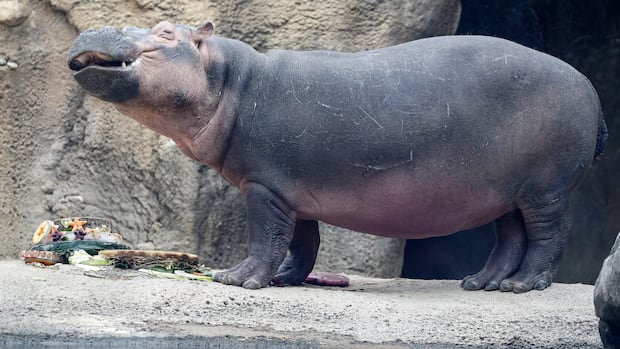
Fiona, the hippo whose early birth and struggle for life at the Cincinnati Zoo made her an international sensation nearly ten years ago, passed away on Thursday due to complications after swallowing a visitor’s hat that was inadvertently thrown into her habitat.
The zoo expressed deep sorrow in a statement, sharing, “It is with great sadness that we inform you of the heartbreaking news that Fiona could not survive despite numerous efforts from our exceptional veterinarians and keeper team to assist her during what became a medical emergency.”
On Monday, the zoo reported that the nine-year-old hippo was receiving continuous care following the incident involving the hat over a week ago.
Prior to her death, the veterinary team had been ensuring Fiona remained hydrated, providing her with treats, and closely observing her condition, according to the zoo.
They even utilized a vibration plate borrowed from a horse farm, encouraging her to stand on it multiple times daily, hoping the vibrations would aid her digestion.
“Despite various attempts to eliminate the hat from her system, it ultimately proved to be insurmountable,” the zoo stated. “The team conducted necessary supportive care in an effort to save her today, but it was unsuccessful, and she did not recover.”
‘An emblem of resilience and happiness’
Within an hour of the announcement, visitors began placing flowers and cards near a hippo statue at the zoo’s entrance. One note read, “Forever our Fiona,” with a heart replacing the letter ‘a’ in her name.
Cincinnati Mayor Aftab Pureval shared his heartache on social media, stating that the city was devastated.
“Fiona represented resilience and joy in Cincinnati. She brought smiles to countless faces, from children and parents to visitors from all over the globe,” he remarked.
Grace Brooks and her two young children, ages three and five, had Fiona on their minds when they visited the zoo on Thursday, before the news of her passing broke. Her children had been discussing Fiona at preschool, she noted.
“They are well aware of Fiona, and we have many books about her,” Brooks said.
-
Fiona, the hippo known for her survival, is under 24-hour medical care after consuming a hat
-
The Current
The killing of Harambe the gorilla ignites discussion regarding zoos
The Cincinnati Bengals also offered their condolences, referring to Fiona in a post on X as “The queen of the Queen City.”
Fiona enchanted audiences around the world following her premature birth in 2017. Her presence was palpable throughout the zoo, which had planned to remain open late on Thursday for the opening night of its typically festive Festival of Lights.
In addition to the hippo statue at the entrance, the gift shop features an entire wall dedicated to hippo-themed merchandise, including shirts, mugs, glasses, and books like A Very Fiona Christmas and You’ve Got This, Fiona.
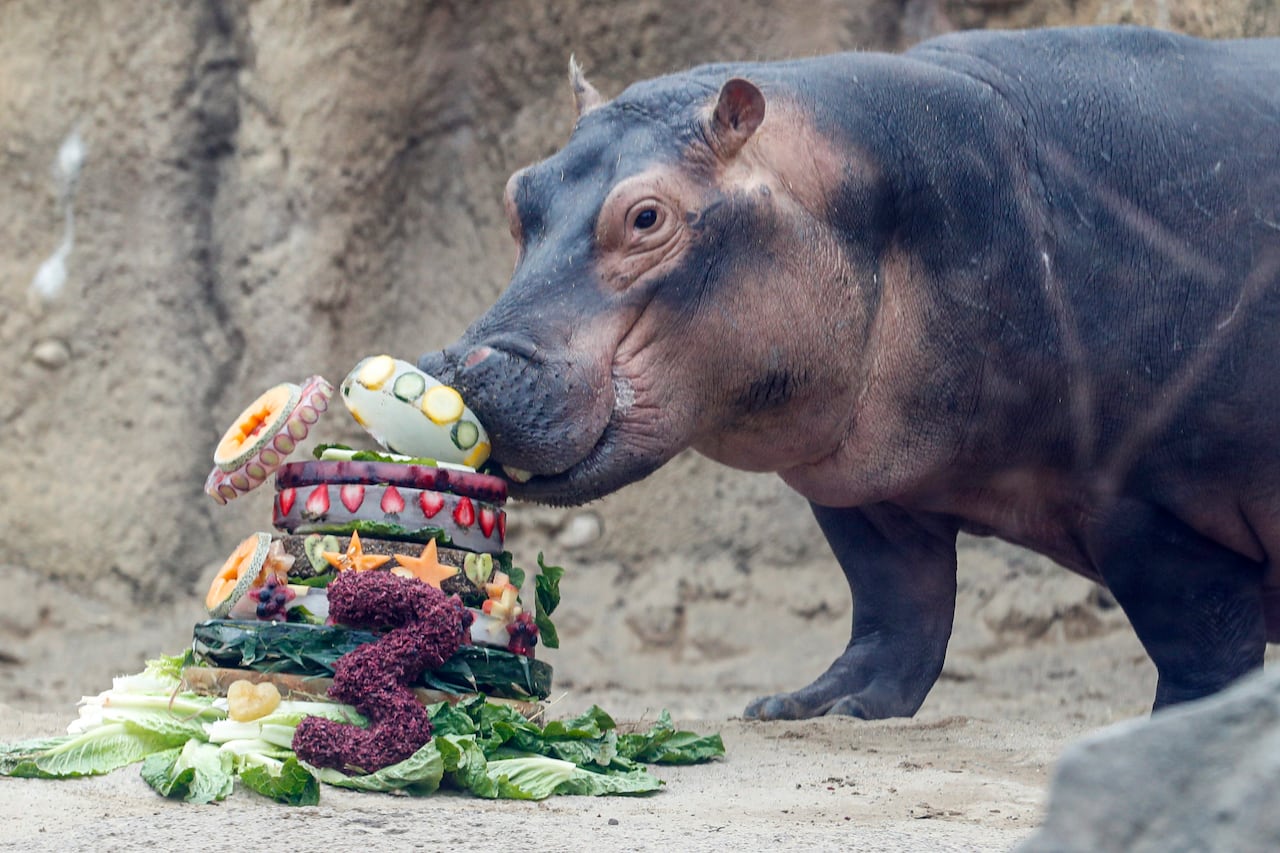
Fiona received her own unique birthday cake on her third birthday in 2020. (John Minchillo/The Associated Press)
Fiona received attentive care
Fiona ingested the hat approximately 11 days prior after a zoo guest tossed it into the air, where a ceiling fan caught it and propelled it through a small opening above the viewing windows of her area.
Zoo representative Michelle Curley indicated that the incident was accidental.
Before her passing, Mike Wenninger, the zoo’s director of animal health, mentioned that veterinarians had sedated Fiona twice to assess her state.
An ultrasound performed on Tuesday revealed some twisting of her intestines, according to Wenninger. They also executed a colonoscopy using a 2.7-meter scope, but he noted they were unable to identify anything unusual.
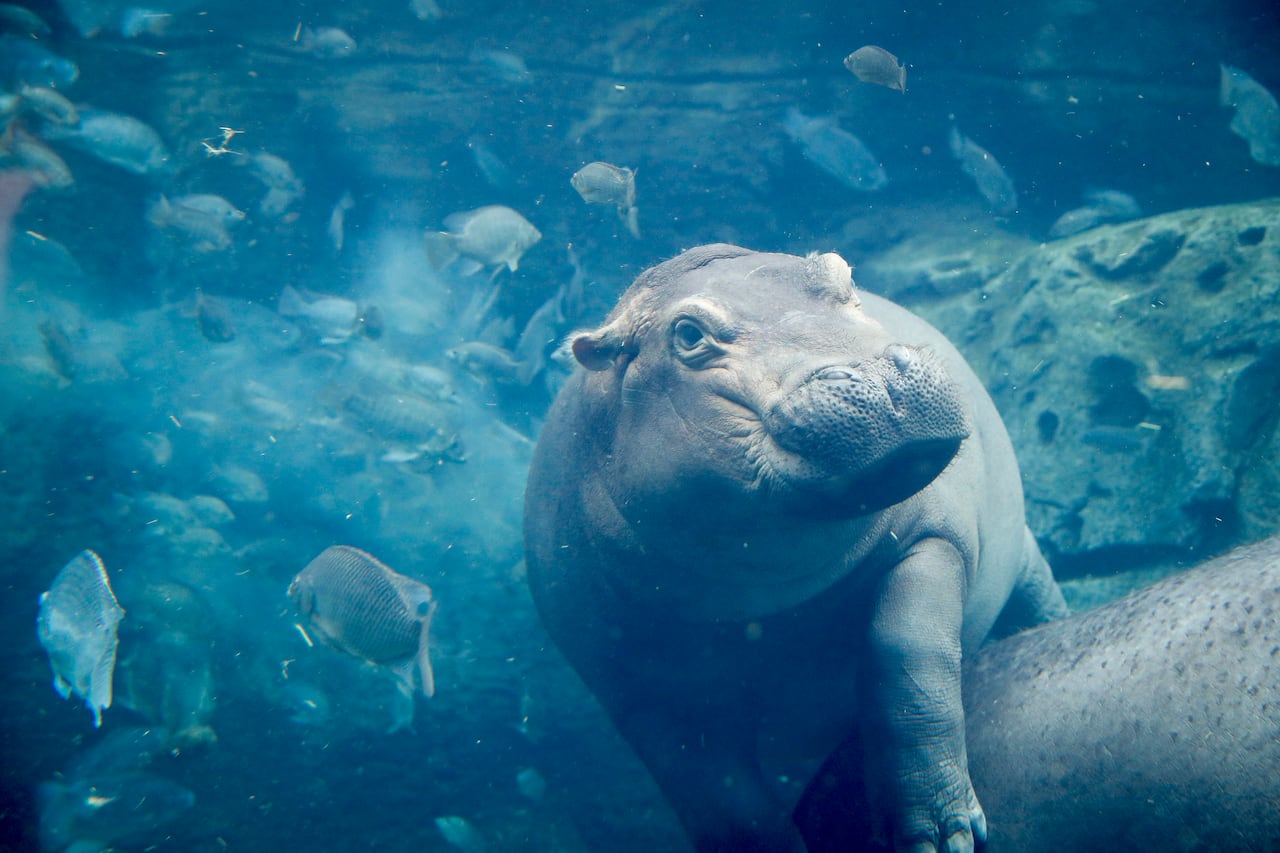
Fiona, pictured here in June 2018, weighed only 13.2 kilograms at birth. (John Minchillo/The Associated Press)
Surgery was not feasible
The zoo reported that specialists advised them that surgery was not a viable option for adult hippos.
According to Jack Kottwitz, an assistant professor at Michigan State University’s College of Veterinary Medicine, hippos have a complex digestive system that complicates Fiona’s situation.
“They possess a multi-chambered stomach for processing vegetation, similar to a cow, but they do not regurgitate or chew cud as cows do,” Kottwitz explained in an email to The Associated Press before Fiona’s death was announced.
He noted that surgery would present significant logistical challenges for various reasons.
To locate the hat, multiple incisions would have been necessary during an extended surgical procedure, he stated. Additionally, hippos are notoriously challenging to anesthetize and have skin that can be over five centimeters thick in certain areas.
-
Toronto Zoo officially names pygmy hippo calf ‘Maple’
-
Video
‘She’s an icon’: World-famous pygmy hippo Moo Deng turns 1
Jan Hawkins, a veterinary doctor at North Carolina State University, mentioned that Fiona’s case was particularly challenging due to the difficulty in pinpointing the location of the hat.
“It’s hard to ascertain because you can’t use the usual imaging techniques available for smaller animals or even horses,” Hawkins remarked.
Other zoo animals have tragically passed away after ingesting foreign objects, and zoos across the globe have long cautioned against the hazards posed by items that are thrown or blown into animal enclosures.
Two years prior, a rare antelope died after choking on the plastic lid of a squeezable fruit pouch at a Tennessee zoo. A polar bear in a German zoo also fatally swallowed a jacket that a visitor had dropped into his habitat in 2014.
Fiona’s premature birth
Fiona overcame her initial health challenge when she was born six weeks premature, weighing only 13.2 kilograms, which was below the lowest recorded weight for her species at that time.
Unable to nurse, she was hand-milked by a zookeeper. The zoo documented her journey with pictures and videos, while fans around the world tracked her progress online.
Her survival marked a positive turn for the Cincinnati Zoo after enduring months of criticism following the shooting of Harambe, the gorilla who became a cultural icon after he was shot and killed in 2016 when a child entered his enclosure.