
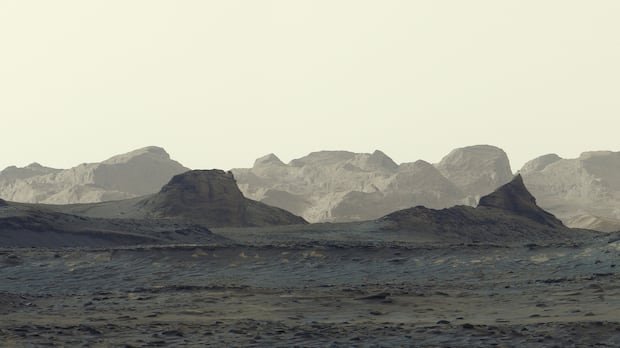
NASA recently unveiled a captivating photograph capturing the break of dawn on Mars taken by its Curiosity rover. The image showcases sunlight illuminating rugged crags that were formed billions of years ago while the car-sized rover continues its exploration of Earth’s neighboring planet.
Since its touchdown in 2012 at Gale Crater near the Martian equator, Curiosity has been steadily ascending Mount Sharp, a towering five-kilometer-high mountain emerging from the crater’s base. The striking image was captured by the rover’s Mastcam camera approximately an hour after sunrise, revealing wind-sculpted cliffs in the distance.
According to NASA’s Jet Propulsion Laboratory in California, planetary scientist Ashwin Vasavada described the distant bright craggy peaks as a distinct rock layer unlike any encountered by the rover thus far. It is believed that wind-blown sediment from nearby volcanic activity settled in the crater and solidified into rock, subsequently eroded by winds over eons into ridges known as yardangs.
The yardang layer is estimated to have originated around three billion years ago, coinciding with the formation of Mount Sharp. While spanning approximately 16 kilometers across the northwestern section of the mountain, Vasavada suggested that these layers were deposited later above an unconformity, representing a temporal gap in geological history.
As Curiosity continues its gradual ascent up Mount Sharp, it has successfully covered nearly a kilometer in elevation, marking the most significant climb ever achieved on Mars. The mountain’s layered structure offers insights into Mars’ geological evolution, particularly the presence of past bodies of water such as lakes and streams when the planet was warmer and wetter.
NASA anticipates that Curiosity will reach the yardang layer by 2027 or 2028, enabling detailed geological analysis using its onboard instruments. Apart from studying Mars’ geology and climate, Curiosity aims to determine if the planet once provided conditions suitable for supporting microbial life. It operates alongside the Perseverance rover, currently exploring Jezero Crater’s periphery in Mars’ northern hemisphere.
The dawn image captured by Curiosity presents an alien yet mesmerizing landscape, akin to a journey through Monument Valley, Arizona, with its vast open spaces and serene ambiance. Despite the familiar scenery, Mars’ distinct orange sky and blue-tinted sunrise remind viewers of the Red Planet’s unique characteristics compared to Earth.

