

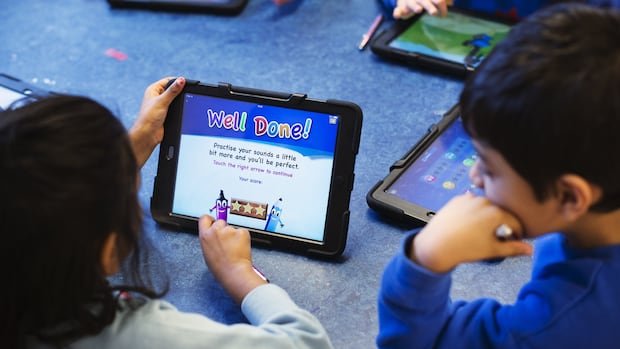
Kim Herrick, who occasionally substitutes for middle and high school students in Nova Scotia, witnesses firsthand how teenagers utilize technology in school settings. Whether students are completing assignments, taking part in other classes, or enjoying free time, Herrick observes them frequently engaging in activities such as checking social media accounts like Snapchat, TikTok, or Instagram, online shopping, gaming, and even trading Bitcoin. These actions often bypass the school board’s security measures designed to restrict such usage.
The prevalence of students engaging in non-educational online activities, combined with the ineffective efforts to control it, has led Herrick to believe that a reevaluation of the default technology used in classrooms is necessary.
Herrick became alarmed when she discovered that her older daughter, who is entering Grade 2, had a school Google account for three years without her knowledge. Despite Herrick’s inability to access the account and the school’s insistence that it was essential for educational apps and learning, she questioned the necessity, stating, “We do not need a Google account to learn.”
Many stakeholders, including parents, educators, advocacy groups, and experts, are expressing concerns about the amount of screen time in schools and the widespread integration of technology tools in the current education system. Some link these issues to various problems, ranging from behavioral issues to data breaches compromising students’ privacy.
Although some education experts argue that reverting to traditional classroom practices is not the solution to the current “techlash,” they advocate for a deliberate and thoughtful approach to technology integration in education.
Reconsidering Technology in Education
For years, advancements like a one-to-one student-to-device ratio, internet access, and gamified learning applications have symbolized progress in education. However, amid global efforts to reduce teenage smartphone and social media usage, a growing number of parent groups are expanding their scrutiny of educational technology usage.
Sweden, after emphasizing digital education for the past decade, has recently shifted back towards physical textbooks, traditional homework methods, reinvestment in libraries, and screen-free classrooms, particularly for younger students, citing declining performance on international assessments.
Norway, facing poor reading scores, is also transitioning back to physical books in schools and implementing restrictions on Generative AI use in elementary schools. In the U.S., parental demands have prompted stricter technology policies at major school boards, with initiatives like screen time limits and device restrictions for younger students.
Herrick, along with many parents, expresses concerns about the lack of transparency regarding the technology and applications accessed by students in classrooms. She also worries about the long-term effects of unrestrained technology use on students’ well-being and the educational system’s efficiency.
Education experts emphasize the importance of intentional and purposeful use of technology in classrooms, emphasizing that tech integration should be directly linked to students’ learning objectives. Teachers must receive adequate training and guidelines to effectively incorporate technology into their teaching practices.
Striking a Balance
Rolling back to technology-free classrooms is not seen as the definitive solution, as technology serves essential functions, especially for students with disabilities. Schools must balance purposeful technology use with preparing students for a tech-driven world while ensuring it does not become a distraction.
Tom D’Amico, a former director of education at the Ottawa Catholic School Board, notes the evolving approach of schools towards technology integration, considering developmental and age-appropriate factors. He stresses the importance of embedding critical thinking skills in the curriculum, even without technology, and prioritizes student learning and relationships over technology in classrooms.

