

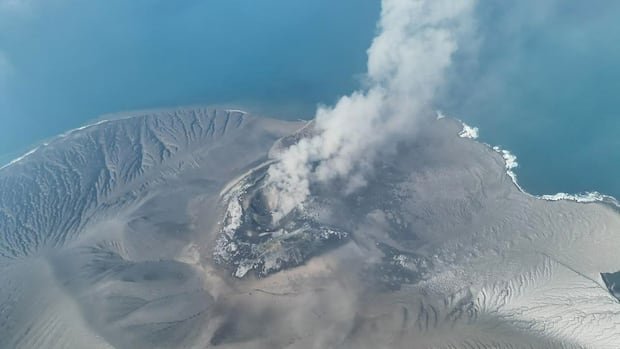
Anak Krakatau volcano in Indonesia erupted on Sunday, leading to the suspension of all flights at Jakarta’s Soekarno-Hatta International Airport and affecting other domestic airports in western Indonesia due to the drifting volcanic ash. The volcanic island in Indonesia’s Sunda Strait, situated between Java and Sumatra islands, had been displaying signs of activity since Friday before erupting twice on Sunday morning at 3:53 a.m. and three hours later, as reported by Indonesia’s Geological Agency. Lava flares from the volcano were captured on closed-circuit camera footage.
Despite the eruption, no casualties were reported, and there was no evacuation order issued as the nearest settlement is more than 16 kilometers away. However, authorities cautioned residents and visitors to maintain a safe distance of at least three kilometers from the active crater. Volcanic ash spread across Jakarta and Lampung province in Sumatra’s southern tip, according to Indonesia’s Centre for Volcanology and Geological Hazard Mitigation.
AirNav Indonesia shut down airspace around Soekarno-Hatta and Halim Perdanakusuma airports in Jakarta, along with six other airports, including Radin Inten II airport in Lampung, due to the presence of volcanic ash. The closure significantly impacted air travel, with 467 flights at Jakarta’s Soekarno-Hatta airport canceled, affecting around 150,000 passengers by Sunday evening local time. The airport remained closed until 11:59 p.m.
Passengers, including Diego Urdiales and Michele Gouw, expressed their understanding of the situation, acknowledging the inconvenience caused by the natural disaster. Indonesia’s Directorate General of Civil Aviation assured close monitoring of the eruption’s impact on air travel, working closely with airlines, airport operators, air navigation services, and the meteorology agency.
The eruption also disrupted operations at Bali’s I Gusti Ngurah Rai International Airport and Medan. Indonesia’s volcanology agency and the Darwin Volcanic Ash Advisory Centre identified two ash clouds through satellite imagery, with one plume rising to 6,100 meters and drifting northeast over several regions, while a second cloud reached 15,200 meters and spread over other provinces and water bodies.
Lana Saria from Indonesia’s Geological Agency highlighted the intensified activity at Anak Krakatau since July, with Sunday’s eruption being the most robust during that period. The continuous eruptions indicate a sustained supply of magma and volcanic gases beneath the volcano, although the likelihood of a larger eruption remains uncertain. The main hazards include volcanic ash, high gas concentrations, and the ejection of hot rocks and materials around the crater.
Anak Krakatau, meaning “child of Krakatau,” is the descendant of the famous Krakatau, known for its colossal 1883 eruption that had global repercussions. A previous eruption of Anak Krakatau in 2018 resulted in a tsunami that claimed hundreds of lives in Sumatra and Java. It was believed that volcanic activity triggered an underwater landslide, causing a significant portion of Anak Krakatau to collapse and displace a large volume of water, leading to its reduced size.

