

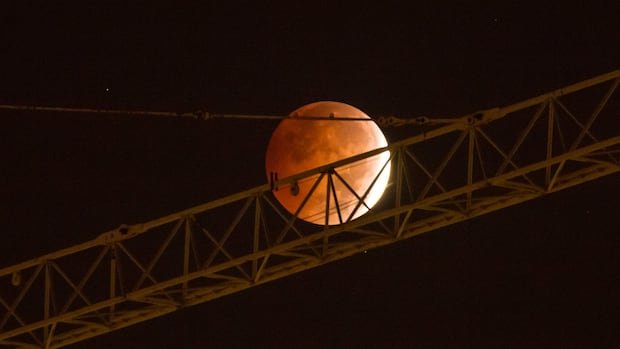
A partial lunar eclipse is set to grace the skies of Canada on the night of August 27-28. Following closely on the heels of the recent total solar eclipse visible in Iceland, Spain, and a portion of Portugal, this partial lunar eclipse will offer a deep spectacle with 93% coverage at its peak.
During a lunar eclipse, the moon traverses the Earth’s shadow, known as the umbra. Before entering the umbra, the moon first passes through the penumbra, Earth’s outer, fainter shadow. The penumbra phase is challenging to observe with the naked eye due to its dimness.
Most regions in Canada will witness the entire eclipse duration, while Western Canada will catch a glimpse of the partial eclipse already in progress as the moon ascends. Unlike solar eclipses, watching a lunar eclipse does not require protective eyewear. Additionally, a lunar eclipse unfolds over several hours compared to the brief moments of a solar eclipse.
The eclipse will commence as the moon enters Earth’s penumbra around 10 p.m. ET; however, the visible phase begins at 10:33 p.m. ET on August 27 and concludes at 1:52 a.m. on August 28. The eclipse’s peak, with nearly the entire moon appearing darkened, will occur at 12:13 a.m.
This event is just one among several astronomical occurrences this month. Elaina Hyde, director of the Allan I. Carswell Observatory at York University, expressed excitement about the eclipse and other celestial events in August. While the lunar eclipse won’t transform into a “blood moon” entirely, observers in certain Canadian locations can expect a reddish hue. Enthusiasts can enjoy this phenomenon with the naked eye, or enhance their experience by using binoculars, a small telescope, or a smartphone camera with night mode for capturing memorable images.

