
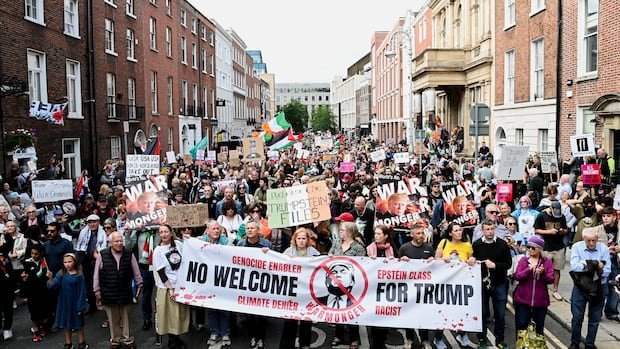
U.S. President Donald Trump expressed his support for the potential unification of British-run Northern Ireland with Ireland during his visit to Dublin, sparking criticism from pro-British unionists in Northern Ireland. Trump’s remarks followed British Prime Minister Andy Burnham’s statement that a referendum on Northern Ireland leaving the United Kingdom was not being considered, a stance confirmed by Downing Street.
During a meeting in Dublin with Irish Prime Minister Micheál Martin, Trump stated, “I’d love to see it unified,” noting that he believes it will eventually happen and would be a positive development. While acknowledging that the United Kingdom would have a say in the matter, Trump emphasized his enthusiasm for the idea.
Trump’s comments diverged from the neutral stance typically taken by previous U.S. presidents, including Bill Clinton, who played a pivotal role in negotiating the 1998 Good Friday Agreement. This agreement stipulates that a referendum on Irish unity can only be held with the approval of the British government. The agreement brought an end to decades of conflict between Irish nationalists and unionists in Northern Ireland.
Despite polls indicating a majority in Northern Ireland preferring to remain part of the U.K., the issue of Irish unity has gained traction following Brexit. The leader of the Democratic Unionist Party, Gavin Robinson, dismissed Trump’s remarks, asserting that the decision on Northern Ireland’s future rests with its people, not external commentary.
Supporters of Irish unity in Belfast reacted cautiously to Trump’s statement, with some viewing it as a headline-grabbing gesture rather than a genuine stance on the issue. Previous U.S. presidents, such as Joe Biden, known for their Irish heritage, have traditionally maintained a neutral position on Irish unification, given the U.S. government’s involvement in the peace process.
Following Trump’s departure to attend a golf tournament in western Ireland, thousands of protesters marched through central Dublin, denouncing the president as a warmonger and advocating for Palestine. The demonstration marked one of Ireland’s largest anti-war protests in recent memory.

