

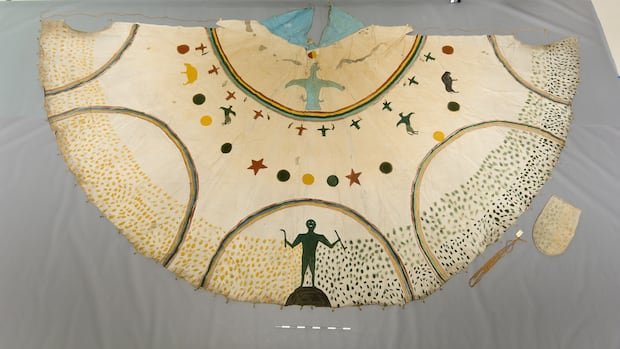
A professor from Saskatchewan unearthed a significant piece of the province’s past at the Smithsonian in Washington, D.C. and is now facilitating its return. Andrew Miller, an Indigenous studies professor at the First Nations University of Canada, stumbled upon a teepee cover stolen from Kawacatoose First Nation in the 1920s while researching birds using the Smithsonian’s catalog.
Despite being taken decades ago, the family managed to keep the memory of the stolen cover alive through generations. Miller, recalling a student’s mention of belongings in prominent U.S. museums, identified the teepee cover labeled “Dustyhorn—File Hills” and dated 1926, prompting him to contact Cory Dustyhorn, the current chief of Kawacatoose First Nation.
Dustyhorn was familiar with the story of his great-great-grandfather Sîpiskwêsîkan’s teepee theft, where promised payment was never received. After reaching out to the museum, Miller and Dustyhorn found the Smithsonian to be cooperative and understanding, acknowledging past collection practices lacking in cultural respect.
The museum showed willingness to repatriate the teepee cover upon confirmation of its rightful community. Dustyhorn’s familial oral history narrating the artifact’s journey from Alaska was validated by the museum’s historical records, solidifying the case for its return.
In response to past unethical acquisitions, the Smithsonian introduced a shared stewardship and ethical returns policy in 2022. This policy acknowledges evolving ethical standards in artifact collecting and aims to rectify past wrongs. Now, a century later, the teepee is finally making its way back to Kawacatoose First Nation.
Dustyhorn expressed gratitude for the return, emphasizing the strengthened ancestral connection within his family and community. Plans are in place to eventually house the teepee in a museum at Kawacatoose, but for now, it will be showcased at the Royal Saskatchewan Museum in Regina.

