

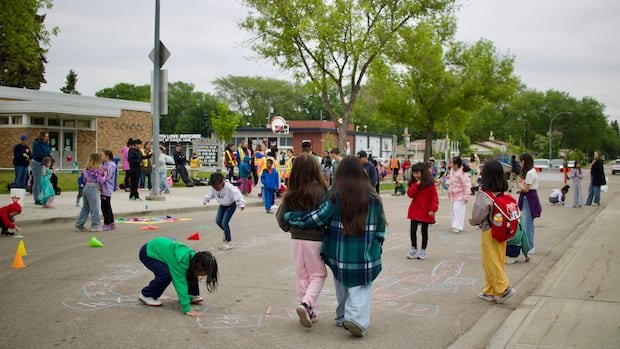
Lily Dejnicki is excited to return to school and hopes to witness a reduction in car traffic during peak hours outside Sts. Peter and Paul Catholic Elementary in Mississauga, Ont.
The 13-year-old is eager for the revival of a pilot initiative that diverted cars away from the regular dropoff area at her school. The project, known as School Streets and endorsed by a non-profit environmental organization, involved volunteers using barricades and signage to redirect traffic during school dropoff and pickup times. The goal was to promote walking and cycling among students and parents instead of relying on cars.
Reflecting on her experience, Lily, who is entering Grade 8, described the initiative as enjoyable. She highlighted how it allowed children to engage in outdoor activities instead of rushing home after school.
Anita Dejnicki, Lily’s mother and a member of the school’s parental advisory council, noted increased parent interactions and more active play among children during the project’s duration.
Green Communities Canada, an environmental association, continues to push for the implementation of School Streets nationwide as the new school year commences. The pilot project at Sts. Peter and Paul Catholic Elementary, which lasted a month, is part of the broader National Active School Streets Initiative. This initiative, supported by a $3 million grant from the Public Health Agency of Canada in 2024, aims to introduce at least 20 School Streets in the 2026-2027 academic year, building on past pilots in six provinces across Canada.
Nicole Roach, the sustainable mobility director at Green Communities Canada, explained that School Streets typically involve temporary barriers on streets adjacent to schools to ensure the safety of pedestrians and cyclists. These streets are carefully selected to avoid major traffic routes and bus or disability access concerns. Roach suggested that driving parents could park nearby and walk the remaining distance to the school as an alternative.
One of the key motivations behind School Streets is to address safety concerns and reduce air pollution caused by vehicular traffic around schools. Roach emphasized the chaotic and unsafe conditions often witnessed during school dropoff and pickup times, highlighting the need for safer environments for children walking or biking to school.
Lily, who walks to school, expressed her discomfort with the usual car queues during dropoff and pickup, emphasizing the crowded and potentially unsafe conditions they create. While most of her friends welcomed the School Street initiative, some were skeptical of its benefits, questioning its necessity.
Challenges and Perspectives
Despite the success of several School Streets pilots in Canada, the long-term implementation of such initiatives has faced obstacles. Only two permanent School Streets currently exist, with some pilot projects encountering resistance.
At Corliss Public School in Mississauga, a School Street project was terminated following objections from a parent, who raised concerns about safety and disruptions caused by the initiative. The cancellation was prompted by a petition signed by nearly 200 individuals, citing increased traffic congestion and safety hazards resulting from the project.
Research conducted by Kerstyn Lutz on four School Street pilots in the Greater Toronto Area revealed initial challenges, including confusion among drivers approaching barriers and the need for clear vehicle diversion plans. Lutz emphasized the importance of addressing logistical issues to ensure the smooth operation of School Streets.
Expert Insights
Contrary to concerns about traffic diversion and safety implications, urban planning professor Raktim Mitra emphasized that School Streets do not necessarily lead to increased congestion on surrounding roads or unsafe driving behaviors. Data collected near School Streets pilots in Mississauga indicated improved road safety measures, including reduced vehicle speeds and increased pedestrian priority.
While acknowledging potential concerns about interactions with strangers, Canada Safety Council spokesperson Lewis Smith highlighted the importance of educating children on recognizing and responding to unsafe situations. Mitra and Lutz noted positive outcomes from School Streets, such as increased active transportation among students and reduced air pollution near schools.
Adapting School Streets to Canadian Context
Although School Streets originated in Italy and have been successfully implemented in various countries, Canada’s car-centric culture presents challenges, particularly in suburban areas where driving is prevalent. Overcoming volunteer shortages and ensuring sustainable enforcement remain key hurdles for expanding School Streets initiatives.
Lucy Maloney, a Vancouver city councillor and former parental advisory committee president, advocated for innovative solutions such as retractable bollards or camera enforcement to ease the volunteer burden associated with School Streets. However, doubts remain about the feasibility of permanent School Streets infrastructure in Canada’s suburban settings.
While permanent School Streets may face challenges in suburban areas, urban locations present opportunities for

