

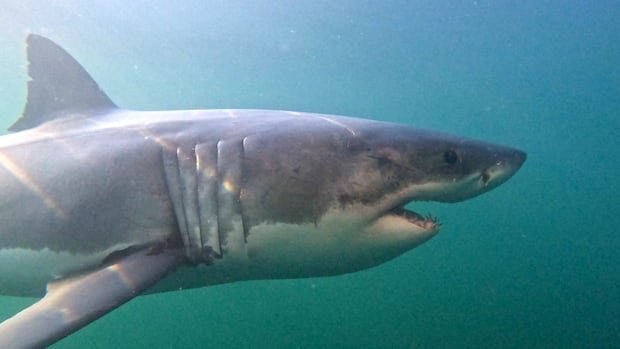
Countries worldwide that are popular among sharks are utilizing drones to identify when the creatures are in close proximity to public beaches. However, officials in Nova Scotia have indicated that they currently have no plans to employ this technology.
Paul D’Eon, the longstanding director of the Nova Scotia Lifeguard Service, acknowledged that lifeguards in Australia and the United States have been utilizing drone technology, but his service has not actively pursued adopting drones. The Department of Natural Resources, responsible for overseeing the province’s public beaches, has not disclosed any intentions to invest in aerial shark surveillance at this time.
The lifeguard service in Nova Scotia monitors 24 public beaches across the province for eight hours a day, seven days a week during the summer season when great white sharks migrate into the warm waters. D’Eon mentioned that in his 52 years of safeguarding Nova Scotian beaches, there have been no shark attacks, although there has been a slight increase in shark sightings.
While two decades ago, beach closures due to shark fin sightings occurred sporadically, it is now a more frequent occurrence, happening about twice a year. D’Eon emphasized that they continuously monitor factors affecting public safety but currently does not recommend the province investing in drones, stating they would reconsider if circumstances change.
In contrast, other regions like New South Wales in Australia have been utilizing drones for beach monitoring since 2015. The state government in New South Wales recently allocated an additional $34 million for drone patrols following a series of shark attacks. Lifeguards using drones spotted sharks 73 times within the first two days of the extended program, according to data from Agence France-Presse.
In New South Wales, drones now monitor 70 beaches year-round, with plans to incorporate artificial intelligence for enhanced shark detection. Similarly, New York State and the New York City Police Department have implemented a drone fleet for shark detection, with the state investing an extra $322,000 earlier in the summer.
Regarding shark sightings at Nova Scotia beaches, a recent incident at Martinique Beach triggered the current protocol of a two-hour beach closure upon shark sighting. Beach visitors expressed that having lifeguard-operated drones patrolling above the water would enhance their sense of safety.
Philip Skinder, the head coach of the Pacific Lifesaving Club in Vancouver, endorsed the use of funds for drone technology, emphasizing its efficiency in enhancing ocean safety. Recent shark sightings have made some individuals apprehensive about entering the water, prompting discussions on the potential benefits of drone surveillance.
D’Eon advised beachgoers to prioritize safety by avoiding swimming during dawn and dusk, and steering clear of seals and active fishing areas.

