

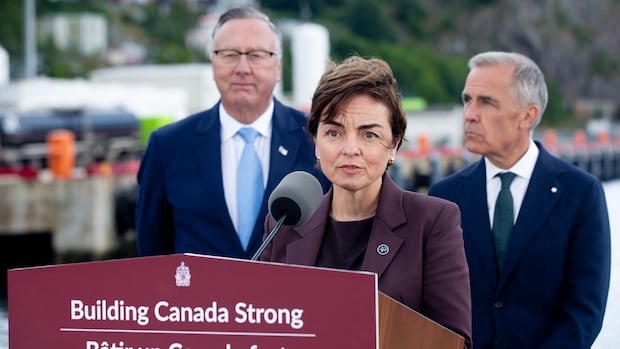
Prime Minister Mark Carney visited St. John’s on Monday to reveal a fresh accord concerning Churchill Falls and additional electricity ventures in Labrador, in the company of N.L. Premier Tony Wakeham and Quebec Premier Christine Fréchette. This initiative is being hailed as the most extensive clean energy investment in North American history, valued at almost $70 billion, with Ottawa contributing $10 billion in federal funding. The allocated funds are earmarked for enhancing and enlarging the Churchill Falls generating station, progressing the Gull Island hydroelectric project, constructing transmission lines, and executing a 2,000-megawatt onshore wind energy project in Labrador. These developments will augment the current generating capacity of Churchill Falls, generating adequate power to illuminate, warm, and cool all residences in Toronto, Montreal, and Vancouver combined.
The agreed framework announced on Monday will remain in force until March 2027. A final agreement is still pending signing, with hopes of sealing the deal by year-end. The looming provincial election scheduled for Oct. 5 implies that a change in government might occur before the agreement is formally ratified.
Under the terms of the agreement, Quebec would acquire over 10,000 megawatts, representing more than a quarter of Hydro-Québec’s total current output. In contrast, the 2024 Churchill Falls Memorandum of Understanding, rejected by Wakeham shortly after assuming office, outlined a total potential of 7,200 megawatts. The electricity produced at Churchill Falls is set to be sold to Quebec at an average price of 6.2 cents per kilowatt-hour, potentially leading to savings of $200 billion over the deal’s duration.
Yvan Cliche, an energy sector expert at the Université de Montréal’s center for international studies, labeled the agreement a “historic milestone” for Quebec. Cliche believes the deal will not only benefit the energy sector but also Quebec consumers by enabling Hydro-Québec to maintain minimal rates.
For Fréchette, the agreement signifies a victory ahead of the campaign and an opportunity to showcase her economic expertise. Describing the deal as a partnership ensuring Quebec’s energy security for the next five decades and creating numerous job opportunities, Fréchette expressed her commitment to formalizing the Churchill Falls agreement if her party secures a third consecutive victory in the upcoming election.
The leaders of the Innu nations Matimekush-Lac John and Uashat mak Mani-utenam, both situated in Quebec’s Côte-Nord region, released a joint statement emphasizing their lack of consultation in the agreement. They stressed the necessity of their participation and consent for any agreement regarding the Churchill Falls project, pointing out that the initial project was executed on their traditional land—Nitassinan—and that their reparations case is currently under review by Quebec courts.
The forthcoming campaign, expected to commence next week, has intensified scrutiny on Fréchette, who assumed office in April. Opposition parties have criticized her for rushing the deal ahead of the election. Parti Québécois (PQ) Leader Paul St-Pierre Plamondon challenged Fréchette’s legitimacy in finalizing a long-term deal just before the campaign, suggesting that such agreements should not be rushed for political reasons.
Other political parties have echoed similar sentiments, with the Quebec Conservatives and Québec Solidaire accusing Fréchette of serving her own political interests with the Churchill Falls deal. These parties have raised concerns about the impact of the agreement on public finances and electricity rates, promising to scrutinize the deal thoroughly if elected into office. Fréchette, in response, has called on opposition parties to present their alternative proposals, emphasizing the potential benefits of the agreement in terms of job creation and energy supply for Newfoundland and Quebec.

