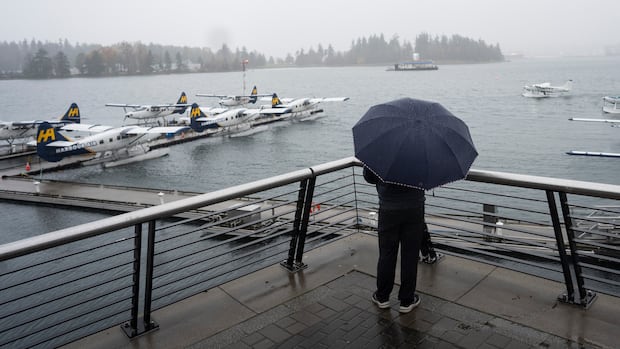
Several flood watches are currently in effect for southwestern British Columbia as another storm system is predicted to affect the region on Tuesday, with forecasts indicating over 250 millimetres of rainfall in certain locations.
Many residents of British Columbia experienced being hit by storms throughout the weekend, causing numerous regions to lose power for several days as trees collapsed onto vehicles and power lines.
While some areas experienced a brief break in the rain on Monday, meteorologists anticipate further rainfall on Tuesday and Wednesday, with localized totals potentially exceeding 250 millimetres, as reported by Environment and Climate Change Canada (ECCC).
According to an orange rainfall warning issued on Monday, “A strong frontal system is expected to arrive on Vancouver Island very early Tuesday morning. Heavy rain will continue until Wednesday morning.”
“Even after the heaviest rain subsides by Wednesday morning, moderate rainfall is still anticipated until Thursday morning.”
-
Effects of Prince George windstorm still being felt, homeowners face long waits to have trees cleared
-
Driver dies after tree falls on car in Surrey as 2nd windstorm hits B.C.
In addition to the orange warning indicating widespread effects for much of Vancouver Island, yellow weather warnings are also active for the North Shore of Metro Vancouver, Whistler, and the Sunshine Coast.
ECCC forecasts that west and central Vancouver Island may receive between 150 to 200 millimetres of rain, with the North Shore expecting up to 120 millimetres.
The B.C. River Forecast Centre has announced flood watches for the South Coast, Vancouver Island, as well as river basins in the Central Coast and Fraser Valley.
The flood watch indicates that temperatures will remain warm through Wednesday, which could result in snowmelt from shallow snowpacks at higher altitudes.
According to the flood watch, “Intense rainfall and high streamflow increase the risk of unstable banks, river erosion, submerged roads, swift water hazards, flooding, and landslides.”
“Stay away from the banks of rapidly flowing rivers and do not attempt to drive across flooded roads, bridges, or river crossings.”
Power outages
As of Monday evening, thousands of customers of B.C. Hydro — particularly in the Central Interior and northern Vancouver Island — were still without electricity following the storms over the weekend.
The utility reported that restoration efforts are ongoing, while also keeping an eye on the additional weather systems expected to move through British Columbia in the upcoming days.
“Access remains difficult in certain areas, with fallen trees, debris, and soft ground conditions impeding repair efforts,” the utility stated in a social media post.
One of the many locations in British Columbia experiencing prolonged power outages is Zeballos on northwest Vancouver Island, where several properties are under evacuation order following a landslide last week.
Road conditions
An orange rainfall warning has also been issued for the Sea-to-Sky Highway, with ECCC indicating that up to 160 millimetres of rain could fall along this route and in the Howe Sound area.
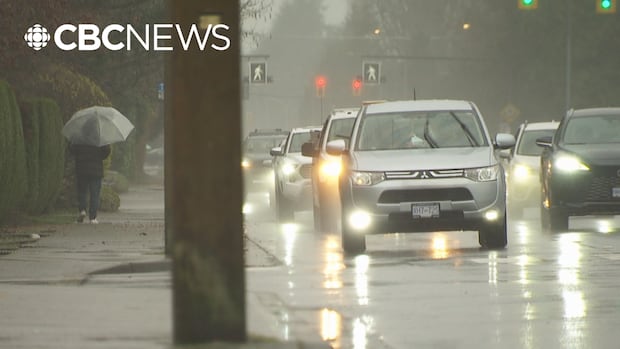
A statement from the Road Safety at Work initiative advised drivers to check DriveBC for the most recent updates and to be ready to adapt their driving to the conditions.
“Visibility may be reduced, tire traction may decrease, and longer distances will be needed to stop safely,” said Trace Acres, a representative for the initiative.
In Vancouver, authorities reported that a 78-year-old woman lost her life after being struck by a vehicle on Friday around 11 a.m. PT at the intersection of Dunbar Street and West 34th Avenue.
The Vancouver Police Department (VPD) stated she was crossing the street at an unmarked crosswalk when a Lexus sedan hit her, with the driver cooperating with the investigation.
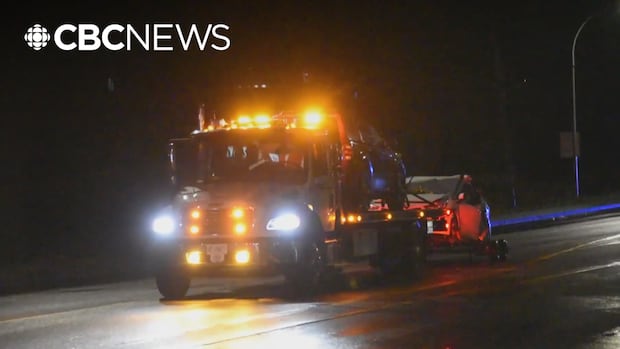
The department is urging pedestrians to make themselves noticeable and drivers to exercise increased caution.
“As evenings grow longer … poor weather significantly hampers visibility,” Sgt. Adam Donaldson stated.
“For pedestrians and cyclists, it becomes extremely challenging to be seen in the rain and darkness.”