
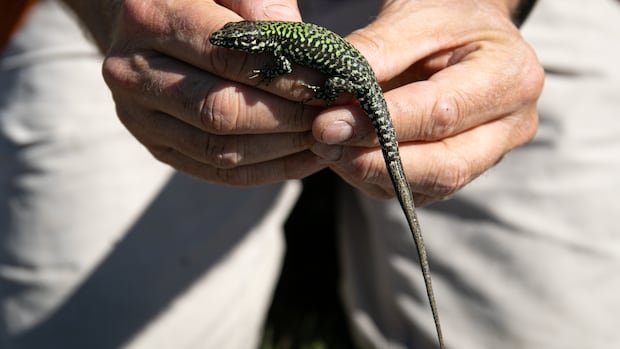
Tracy Menzies had been battling slugs in her backyard garden for some time, but this year, her strawberries flourished beautifully. The reason behind the slugs’ decline seems to be the rise of the invasive European wall lizard, rapidly expanding its presence and devouring various prey, including slugs.
Living near the Gorge Waterway in Saanich, Menzies observed an increasing number of wall lizards darting through her garden, suggesting they might be feasting on the slugs. These lizards, typically a few inches long, have been spotted as large as eight to ten inches in North Saanich and even in crawl spaces, according to Menzies, who works as a real estate agent.
Gavin Hanke, the curator of vertebrate zoology at the Royal B.C. Museum, estimates there are around 800,000 to a million European wall lizards in British Columbia, predominantly on Vancouver Island, extending their reach up to Campbell River, 220 kilometers north of Victoria. Hanke expressed concerns about their rapid proliferation potentially leading to severe environmental consequences, emphasizing the need to adapt to coexisting with them.
Biologist Nicholas Wong from the Invasive Species Council of B.C. highlighted the absence of official management programs to monitor the lizards’ population growth. He noted that these lizards are competing with native species for resources and habitat, posing a challenge to the local ecosystem.
The introduction of the European wall lizards to B.C. traces back to a deliberate release of 12 lizards in 1970 after the closure of a roadside zoo in Central Saanich. These lizards, originating from Italy, thrive in the climate of southern Vancouver Island with its cool winters and hot summers. Their spread typically advances by about 100 meters annually, facilitated by hitchhiking on vehicles or materials like firewood.
Despite aiding in pest control, concerns about the lizards’ spread persist among residents like Menzies, who hopes to find a balance between coexistence and managing their presence. Hanke recommended maintaining a less attractive habitat for the lizards as a preventive measure, emphasizing the need for a collective effort within communities to address the issue effectively.
Acknowledging the irreversible spread of the lizards, Hanke emphasized the human role in disrupting ecosystems, enabling invasive species like the European wall lizard to thrive. He cautioned against relocating the lizards to new areas, as this could further expand their range, potentially reaching locations like Washington state in the near future.

