

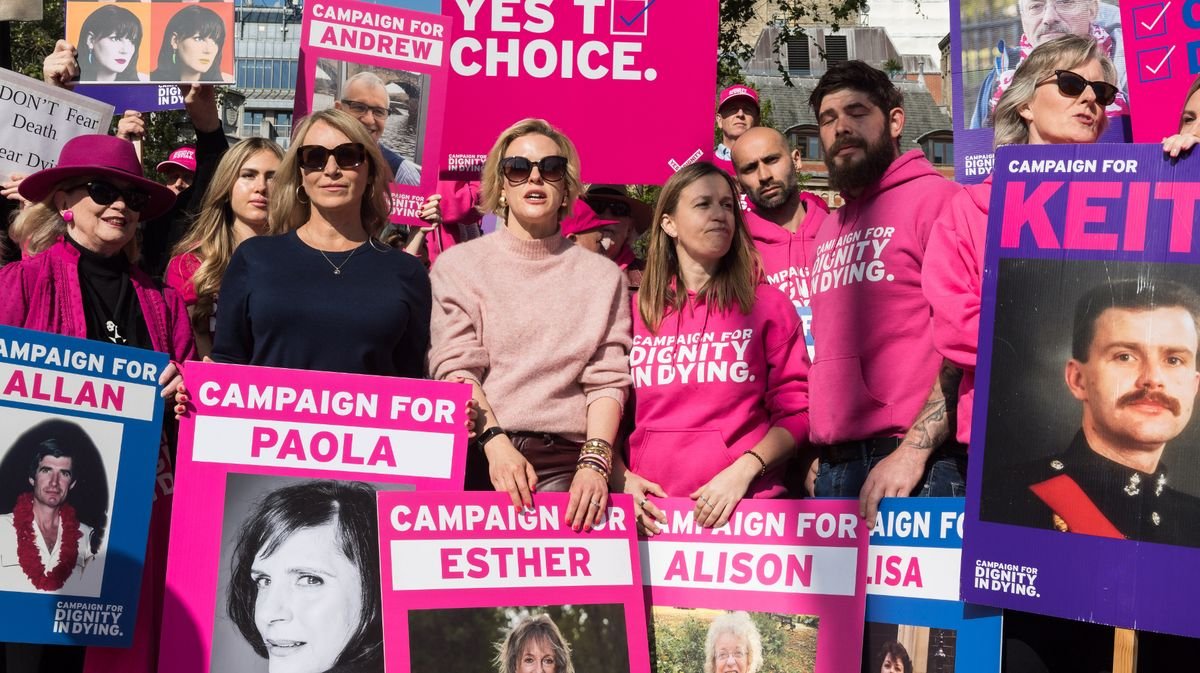
Keir Starmer has disappointed campaigners and individuals facing terminal illnesses by indicating that the Government will maintain a neutral stance on a fresh attempt to legalize assisted dying.
Last year, Members of Parliament approved the bill in an unprecedented vote in the Commons, but the initiative allowing terminally ill individuals to choose to end their lives was thwarted in the House of Lords in May. Advocates of the legislative change accused Lords of intentionally introducing numerous amendments to ensure the bill ran out of time.
Labour MP Lauren Edwards is set to reintroduce the fight today with a new private members’ bill that mirrors the legislation initially championed by colleague Kim Leadbeater.
Granting sufficient parliamentary time to the bill could mitigate the risk of it stalling in the Lords. However, when asked if the Government would support Ms. Edwards’ bill, the Prime Minister, speaking at the G7 summit, confirmed that the same approach would be maintained this time around.
He stated, “The government’s approach to the new bill, essentially mirroring the previous one, will remain neutral. We will handle it in the same manner. I am aware that there are diverse and firmly held opinions not only within my party but also across Parliament on this issue, as we have previously witnessed.
“The government’s approach to this bill will be consistent with its stance on the bill that lapsed due to the King’s speech or the new session.”
The bill will undergo its initial parliamentary phase today, with the actual debate by MPs scheduled for the second reading in September. Ms. Edwards secured the second position in the Private Members’ Bill ballot, granting her the chance to propose a bill to amend existing legislation.
Her bill closely resembles the one put forward by Ms. Leadbeater, allowing terminally ill individuals in England and Wales with less than six months to live the option to seek an assisted death, subject to approval from medical and legal professionals.
Ms. Edwards shared with The Mirror earlier this week, “Many individuals are living in highly anxious and challenging circumstances – either themselves or their loved ones – and are simply urging us as policymakers to fulfill our responsibilities and follow through on the previously supported legislation. I believe there is a duty for us to do so.”
Andrew Copson, the chief executive of Humanists UK, commended her efforts to rectify the “injustice” of the bill’s previous failure. He remarked, “It is rectifying an injustice after being undemocratically obstructed in the House of Lords. We cannot allow a small group of unelected peers to determine the end-of-life choices for all of us.”
Nevertheless, critics cautioned that the bill had significant flaws. Labour MP Ashley Dalton expressed, “It is disheartening to see my colleague Lauren Edwards MP reintroducing the deeply flawed and unsafe Assisted Dying Bill as a PMB.
“If it was safe and excellent, why did the Lords sponsor introduce 77 amendments in the Lords? It cannot simply be resurrected in its current form and pushed through.” The bill will be tabled in Parliament today and is anticipated to be debated in September.

