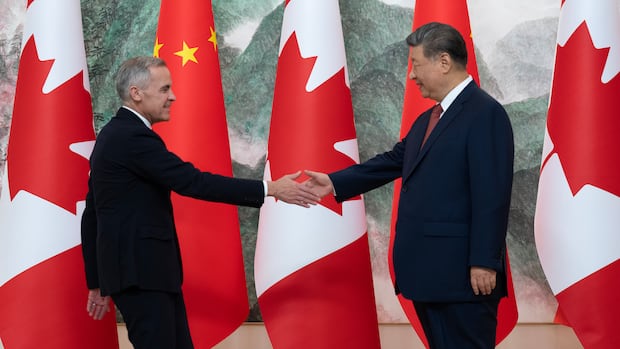
Prime Minister Mark Carney has successfully negotiated another trade agreement with China, aimed at providing significant relief to Canadian industries that have faced obstacles due to tariffs and bureaucratic hurdles.
However, Ottawa is also making its own compromises, causing unease among some critics of China.
Canadians have been detained in China in connection with the Meng Wanzhou incident, where the Huawei executive was placed under house arrest at the behest of the U.S. due to fraud allegations. Additionally, a foreign interference inquiry in 2024 identified China as “the most active foreign interference actor” in Canada.
Last year, during a debate among leaders, Carney labeled China as the “largest security threat” to Canada. His administration has instituted a new registry for foreign influence to mitigate interference from China and other nations.
With the relationship with the U.S. currently unstable due to the Trump administration imposing potentially devastating tariffs on Canadian goods, Carney has adopted what he calls a more “pragmatic” and “constructive” approach toward China while ensuring that “guardrails” are in place to prevent excessive entanglement between the two nations.
Following a meeting with Chinese President Xi Jinping on Tuesday, the Prime Minister’s Office released a statement indicating that Carney had agreed to “further elevate this partnership” with China.
According to the PMO, “The leaders concurred that the citizens of both nations are reaping the benefits of these renewed connections between Canada and China.”
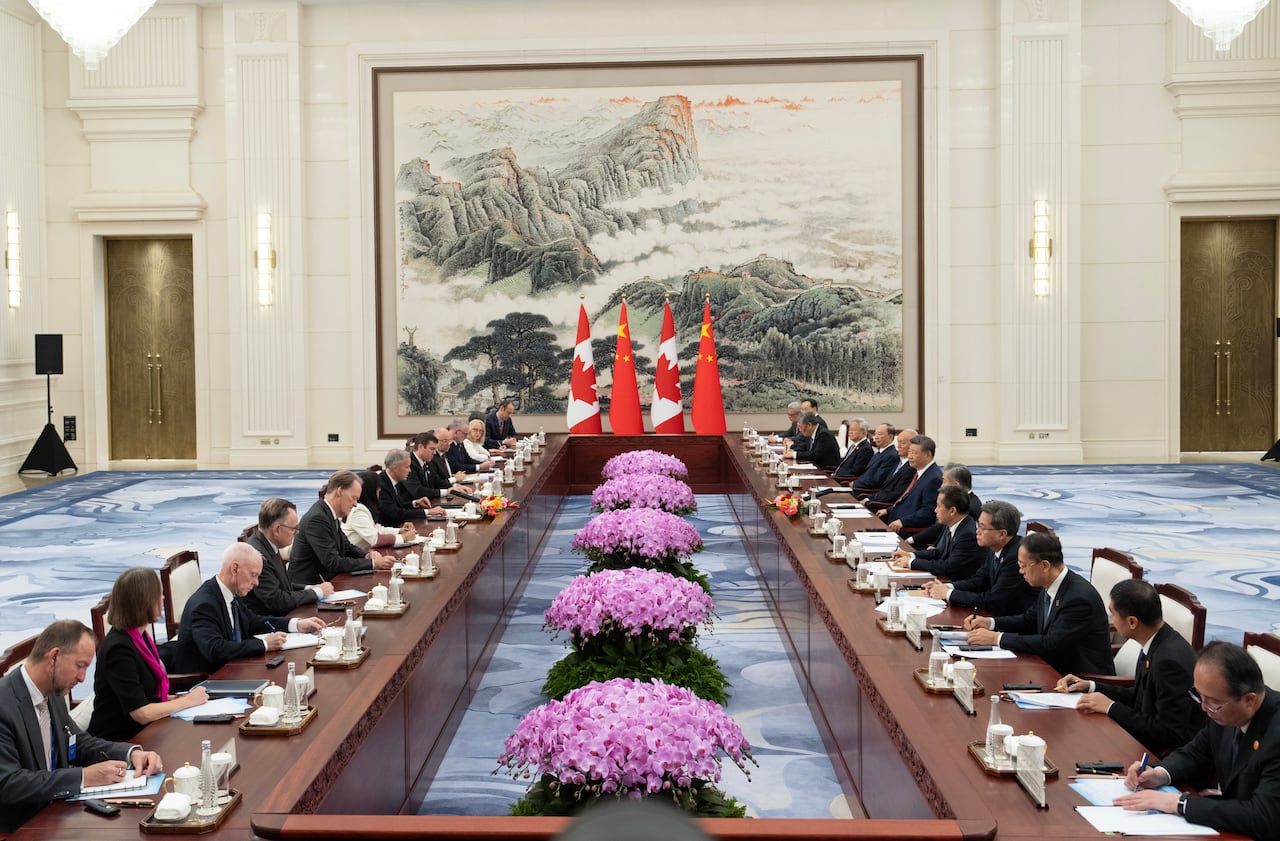
The Carney-Xi meeting took place on the sidelines of the APEC summit in Shenzhen, China. (Adrian Wyld/The Canadian Press)
Michael Kovrig, a former diplomat detained in China following Meng’s arrest, expressed a “great deal of concern” regarding the improving relations and urged Carney to proceed with caution.
In an interview with CBC News, Kovrig acknowledged that relations with China have indeed improved but emphasized that “they have not returned to normal and should not be.”
“There are certainly potential advantages. The challenge lies in ensuring that these benefits do not come with greater and more troublesome drawbacks,” he remarked.
Kovrig pointed out that China has previously used tariffs as a weapon against Canadian farmers and could do so again.
“The statement makes no mention of national security, transnational repression, human rights concerns, or the situation of Canadian detainees in China. These issues should be prioritized alongside market access,” he stated.
Kovrig warned that closer ties with China and the introduction of new imports like electric vehicles and steel products could irritate the Americans, putting at risk what he describes as Canada’s most crucial economic relationship.
“Washington must be prioritized. I understand that this may not be a popular viewpoint in Canada at the moment,” he added.
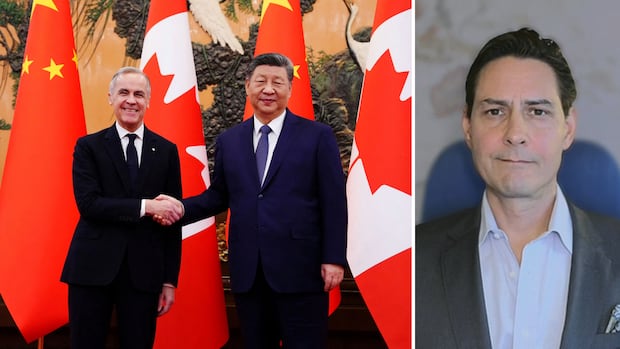
Michael Kovrig, a former diplomat who endured over 1,000 days of captivity in China on espionage charges, emphasizes that the trade relationship between Canada and China, though significant, needs careful handling. He believes that the benefits of Prime Minister Mark Carney’s latest trade agreement disproportionately favor China over Canada.
Trump himself has negotiated trade agreements with China — referring to Xi as a “great leader” — while his administration is currently dealing with the repercussions of an alleged affair involving the former Nvidia CEO and a supposed Chinese spy.
Trump’s commerce secretary, Howard Lutnick, has also been accused of advocating for the relaxation of U.S. chip export regulations to benefit Asian AI data centers that collaborate with China.
Despite the controversies, Peter Navarro, a trade advisor to Trump and a frequent critic of Canada, described Carney’s engagements with China as “extremely offensive.”
“China is going to consume Canada,” he asserted.
Nevertheless, early indications suggest that overlooking China’s past misconduct is yielding positive outcomes for Canadian companies and their workforce.
Xi has consented to eliminate “anti-discriminatory tariffs,” which can reach up to 25 percent on approximately $400 million in Canadian pork and seafood products — a strategic move that grants immediate advantages to these sectors by facilitating access to China’s extensive food market.
In addition, Xi has pledged to increase imports of lentils, fava beans, “wild aquatic products,” and pet food, along with other agricultural goods, while also continuing the tariff suspension Carney obtained in January for Canadian canola meal, peas, lobster, and crab, which has significantly benefited the economy.
Indeed, since Carney’s initial meeting with Xi, along with what the government claims to be 35 additional ministerial visits aimed at resolving bilateral tensions, Canadian exports to China have surged.
According to data from Statistics Canada and figures from the University of Alberta’s China Institute, Canadian trade with China reached an unprecedented $12.7 billion in the last quarter.
The monetary value of Canadian goods exported to the Asian economic giant has risen by 60 percent over the past two years, a result of Carney’s efforts to mend relations with Beijing.
Kyle Larkin, the president and CEO of the Canadian Meat Council, stated that pork producers have faced hardships due to Chinese restrictions, and Carney’s agreement to lift many of these restrictions is “a significant step in the right direction.”
“We are very pleased,” he conveyed to reporters in China.
Vina Nadjibulla, co-founder and CEO of the Centre for Strategic Statecraft, remarked that U.S. trade policies compel Canada to seek alternative markets for commerce, even if there are ongoing concerns about engaging with a nation like China.
“China’s conduct remains unchanged, but Canada’s strategic situation has shifted,” Nadjibulla stated in an interview.
“We now exist in a world where diversification is essential, and we must engage economically with China in specific sectors. However, I hope we remain prudent and strategic, not losing sight of past lessons.”
In exchange for this expanded access, Carney is broadening the opportunity for Chinese steel and aluminum imports by extending and expanding remission measures for products not available in adequate quantities within Canada.
There is also a vague promise to “enhance cooperation” in the area of “finance.”
Moreover, Carney will continue to permit tens of thousands of Chinese electric vehicles to enter Canada each year at a reduced tariff rate, although the number imported thus far is significantly lower than this year’s quota of 49,000.
A backgrounder on the Carney-Xi agreement shared with reporters indicates that, following prior approvals for BYD, a second unnamed Chinese firm has recently obtained the necessary permissions from Transport Canada to bring in its foreign-made vehicles.
A government representative confirmed that Geely, an automotive group with interests in brands like Zeekr, Polestar, and Lotus, has now received approval.
Much of Canada’s automotive sector has strongly opposed granting access to Chinese companies, fearing that a surge of low-cost, state-subsidized vehicles could undermine remaining Canadian automobile and parts manufacturing.
While the Carney administration previously anticipated significant manufacturing investments from Chinese electric vehicle producers in Canada, no such investments have materialized, and the information released to journalists suggests none are forthcoming.
Flavio Volpe, president of the Automotive Parts Manufacturers’ Association (APMA), advised CBC News that Ottawa must resist the temptation to permit Chinese companies to import “knock-down” vehicle kits for assembly in Canada.
Volpe noted that Chinese companies have assured other nations like Brazil that these kits would only serve as a preliminary step until they establish local manufacturing capabilities, only to later backtrack on those commitments.
He emphasized that these kits do not incorporate Canadian components, would jeopardize the domestic industry, and could frustrate the U.S., which supplies many parts to Canadian assembly facilities.
“Does this jeopardize any potential trade agreement with the Americans? It certainly draws their attention,” he commented regarding the prospect of an influx of Chinese-manufactured vehicles in Canada.
While there is apprehension within the industry, Carney is demonstrating a willingness to collaborate with these Chinese firms amidst a strained relationship with the U.S.
“We have the finest auto workforce in the world, and we want them fully engaged and presented with every opportunity in an integrated North American market,” Carney stated to reporters accompanying him on his nine-day trade mission.
“That market has become less integrated due to U.S. trade policies.”