
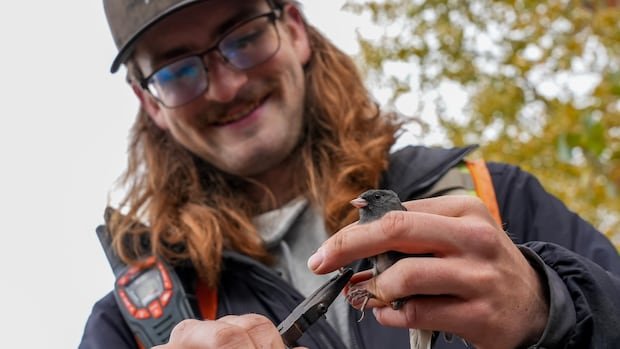
In the midst of a boreal forest, Ethan Denton, a Calgary-based ornithologist working in Fort McMurray, Alberta, carefully bands a small dark-eyed junco, a grey songbird, near a network of nets. Denton records the bird’s details and releases it, contributing to a broader study of migration patterns by researchers continent-wide.
Ken Foster, a co-founder of the Wood Buffalo Wildlife Research Institute (WBWRI), oversees the bird-banding efforts, emphasizing the institute’s unique role in long-term bird monitoring in the oilsands region. Foster highlights the importance of understanding bird population trends to aid conservation efforts.
While various organizations have conducted research in the oilsands region, including the Oil Sands Monitoring Program and the Alberta Biodiversity Monitoring Institute, WBWRI, established in 2024, stands out for its focus on sustained monitoring and citizen science involvement.
Foster’s research, aided by Owl Moon Environmental Inc. (OMEI), indicates significant declines in certain songbird species due to habitat changes from wildfires and industrial activities. In contrast, adaptable species like clay-colored sparrows thrive in disturbed areas, showcasing the complex responses of birds to environmental shifts.
The collaboration between WBWRI and energy companies underscores the importance of industry support for wildlife research. Foster envisions expanding outreach and educational initiatives through research projects to raise awareness about bird conservation.
WBWRI’s efforts extend beyond bird banding to include tracking animal movements and monitoring bat populations. Foster aims to secure funding for radio transmitter tagging of birds and wildlife rehabilitation training for volunteers, emphasizing the organization’s commitment to addressing environmental challenges.
Local studies like WBWRI’s contribute valuable data for understanding regional wildlife trends, as highlighted by experts like biology professor Erin Bayne from the University of Alberta. Integrating local findings with national databases enables targeted conservation actions and informs policy decisions.
In conclusion, WBWRI’s multifaceted approach to wildlife research not only sheds light on bird populations but also underscores the importance of community engagement and data-driven conservation efforts in the Fort McMurray region.

