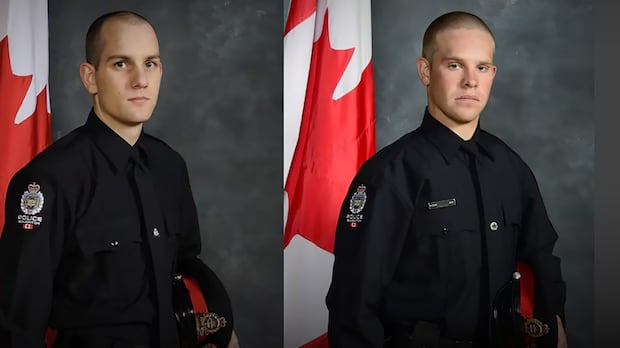
Ashley Ryan’s most vivid recollection of her husband is the moment she wiped blood from his face shortly after he was shot while answering a domestic disturbance call in Edmonton four years ago.
Ryan, a paramedic with 13 years of experience, shared this harrowing experience in court on Tuesday, presenting her victim impact statement during the sentencing hearing of 22-year-old Dennis Okeymow.
Constables Brett Ryan and Travis Jordan lost their lives in March 2023 after they responded to an incident at an apartment complex.
They were attacked and shot by 16-year-old Roman Shewchuk, who subsequently turned the gun on himself.
The court heard that weeks before the incident, Okeymow had sold a semi-automatic rifle to the teenager, who had a documented history of mental health issues.
In May, Okeymow was convicted on ten charges, including three counts of manslaughter and three counts of criminal negligence that resulted in the deaths of both officers and the shooter.
Ashley Ryan recounted being at the Royal Alexandra Hospital when Jordan was brought in. She attempted to revive him, and shortly thereafter, an ambulance arrived carrying her husband.
“The blood-curdling screams that I let out when I realized that it was Brett on that stretcher will never not echo in that ambulance bay,” Ryan, who was 15 weeks pregnant with their first child at that time, stated.
“I cleaned up my husband’s blood and brain matter off his face and his beard. So when our family and friends came to say goodbye, they didn’t have to witness the carnage done to him and see the way that I saw him for the last time.”
She expressed that due to Okeymow’s actions, she is now forced to endure the “images being forever etched in my mind.”
Ryan mentioned suffering from post-traumatic stress disorder, anxiety, and depression, which has made it impossible for her to continue her cherished career.
With treatment, she has achieved “basic human functioning” and is able to be present for her son, she noted.
“I now have to be both mom and dad — the role Brett was looking forward to and so excited for.”
Her impact statement was among eight presented during the hearing.
The prosecution is advocating for a prison term of 12 to 14 years, while the defense is requesting 4.5 years of credit for time already served, followed by three years of probation.
Justice John Little of the Court of King’s Bench will render a decision at a later date.
Laurie Ryan informed the judge that her son’s death forced her to leave her health care profession.
The former ER nurse recounted that upon seeing her son’s lifeless body in the hospital, she began performing CPR, hoping he would breathe again.
“For 35 years, I walked into emergency departments where people were frightened, injured, suffering and sometimes fighting for their own lives. I knew what to do,” she said.
“But when it was my own son lying there, all those years of experience could not save him… that helplessness is something I struggle with every day.”
She stated she can no longer enter a hospital without being flooded with sorrow.
Annie Jordan expressed that the heartbreaking loss of her husband was solely due to someone selling a firearm illegally.
“A single act can send shock waves through countless lives,” she told the court.
The trial revealed that Shewchuk’s mother had contacted police for assistance when her son assaulted her. She was also shot and wounded when he opened fire on the officers.
Days prior, the teenager had used the same weapon to shoot a stranger in the head at a pizza restaurant. Richard Albert survived but sustained serious and permanent injuries.
Okeymow expressed his regrets in court to the families of the officers and the police department.
“I understand that words won’t change what happened that day, but I apologize. I’m sorry,” he stated.
Prosecutor Adam Garrett asserted that Okeymow should have recognized the dangers of unlawfully selling a .22-calibre semi-automatic rifle along with 80 rounds of ammunition to Shewchuk.
Okeymow was also aware or “wilfully blind” to the teenager’s mental health challenges and had a history of selling him drugs, Garrett noted.
He added that when Okeymow learned about the shooting at the restaurant and suspected Shewchuk might be the assailant, he failed to alert anyone.
Jamil Sawani, Okeymow’s attorney, mentioned that his client was just 18 at the time of the charges and that the prosecution’s recommended sentence would “consume the rest of his young adult life.”
Sawani shared excerpts from his client’s pre-sentencing Indigenous background report, highlighting the disruption Okeymow’s family experienced due to the residential school system.
The attorney explained that Okeymow’s mother grew up without her parents and lacked parenting skills.
Okeymow was “born into tragedy,” went into foster care twice, and witnessed his mother attempt suicide. She also taught him how to sell drugs, according to Sawani.
However, he noted that his client has made strides in his life while incarcerated, reconnecting with his Indigenous heritage and completing high school.
“The deaths of Const. Jordan and Const. Ryan cannot be undone, the death of Mr. Shewchuk cannot be undone,” Sawani said.
“What remains in the court’s power is whether this tragedy claims one other promise of a life that could be different.”