
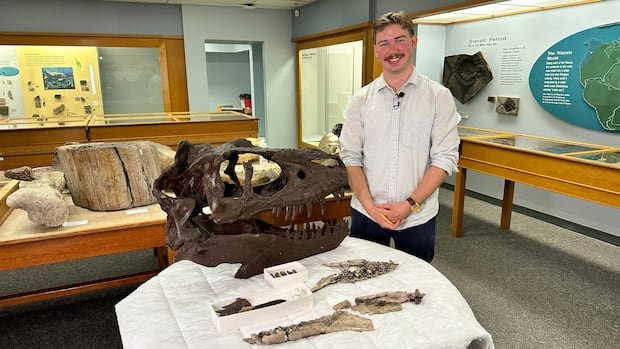
Researchers from the University of Alberta have uncovered a surprising revelation suggesting that a raptor dinosaur might have feasted on a larger tyrannosaur. The discovery was made through the observation of bite marks on the jaw of an Albertosaurus, a species closely related to the renowned Tyrannosaurus rex, known as its “adolescent relative,” which inhabited the Alberta region around 70 million years ago.
The fossil, belonging to an eight-year-old Albertosaurus that had not yet reached full maturity, prompted researchers to contemplate two contrasting scenarios regarding the dinosaur’s fate following its demise near Drumheller, Alberta. The prevalent theory suggests that a smaller, bipedal, carnivorous raptor consumed the larger Albertosaurus post-mortem, shedding light on a rare instance of carnivore cannibalism in dinosaurs.
Philip Currie, a professor at the University of Alberta specializing in dinosaur paleobiology, emphasized the significance of this finding, underscoring the dominance of Albertosaurus as a prime predator during that era. This revelation stands to enhance our understanding of the dynamics between carnivorous dinosaurs and the intricate web of prehistoric food chains.
Led by Joshua Doyon, a master’s student in paleontology at the University of Alberta, the research team analyzed the spacing between the bite marks to deduce that a raptor was the probable culprit, challenging an alternative hypothesis proposing cannibalization by a much younger Albertosaurus.
The discovery originated in 2022 when a member of the public stumbled upon the fossil while exploring the badlands north of Drumheller. Subsequently reported to the Royal Tyrrell Museum, the specimen was meticulously prepared for analysis, unveiling the tooth marks that sparked Doyon’s investigative research in 2023.
Doyon’s interest in studying dinosaur behaviors and inter-species interactions led to a deeper examination of the fossil, offering valuable insights into ancient feeding interactions. Currie emphasized the importance of scrutinizing such details on fossils to glean insights into dinosaur biology and ecosystem dynamics, beyond mere animal identification and description.
The finding, showcasing a carnivorous dinosaur feeding on a counterpart rather than herbivorous prey, provides unique evidence of prehistoric interactions. It underscores the distinction between the smaller, actual raptors like Atrociraptor in Alberta and their larger Hollywood depictions, urging closer attention to small tooth marks on dinosaur fossils for future discoveries in paleontology.

