
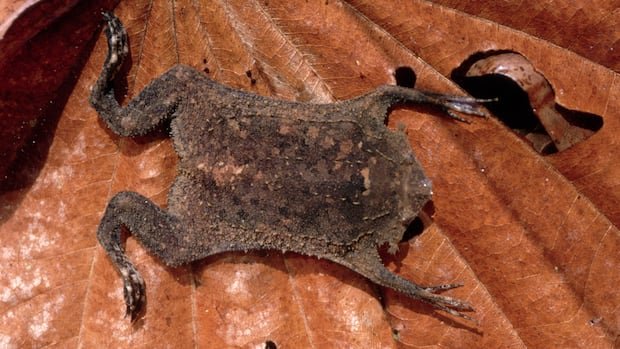
In the depths of the Amazon basin, the Surinam toad stands out as an extraordinary creature with its peculiar characteristics. From its unique method of giving birth to its flat, tongueless form resembling a dead leaf, this toad has always intrigued scientists.
Researchers in California have now uncovered a fascinating ability of the Surinam toad: it can essentially “see” with its fingertips. Despite its limited vision and murky habitat, this toad excels as a skilled predator, swiftly capturing prey with its powerful suction feeding technique.
A recent study by Duncan Leitch and his team at the University of California, Los Angeles, revealed that the star-fingered toad utilizes its fingertips to detect subtle water movements caused by nearby prey. These specialized fingertip lobes act as sensitive touch organs, akin to the high-resolution sensors found in the human eye’s fovea.
With 128 tiny lobes and an abundance of papillae on its fingertips, the Surinam toad’s skin is exceptionally sensitive, allowing it to identify the size and proximity of potential prey without direct contact. This unique sensory adaptation enables the toad to swiftly capture fish or worms that come within a hair’s breadth of its fingertips.
Interestingly, the toad’s brain devotes a significant portion of its processing power to the fingertips, showcasing a strategic allocation of sensory resources. This finding suggests a parallel evolution between frogs and mammals, highlighting a common solution to maximizing sensory input from specific body areas.
Lea Randall from the Wilder Institute in Calgary emphasizes the significance of this discovery, noting that it provides insights into how vertebrates have evolved complex sensory systems over millions of years. By studying the Surinam toad’s sensory adaptation, researchers gain valuable knowledge about the diverse strategies animals employ to thrive in their environments.

