
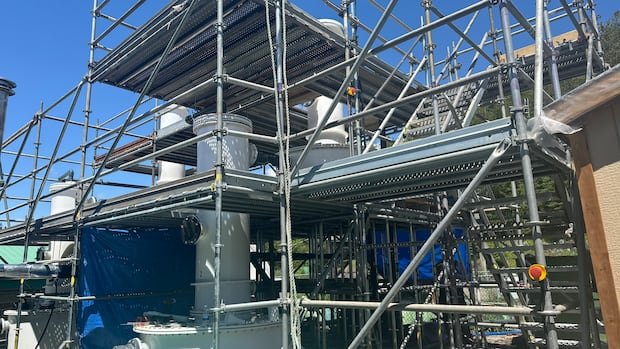
A startup in Nova Scotia is currently conducting trials on a technique to capture and retain more carbon in the ocean through a new experimental facility to validate the concept. Over the years, the ocean has served as a significant repository for excess carbon dioxide, absorbing approximately 30% of all human-induced carbon emissions since the 1980s.
The company, pHathom, is striving to further reduce emissions from the atmosphere by trapping carbon dioxide and transforming it into a form suitable for safe storage in the ocean for thousands of years. The initial testing of this method will take place at the Huntsman Marine Science Centre in St. Andrews, New Brunswick.
Kimberly Gilbert, the co-founder and CEO, emphasized that demonstrating the safety and efficacy of the approach through the pilot project is crucial, especially since addressing climate change necessitates local solutions that are proven to be secure.
pHathom’s technique imitates a natural process where raindrops absorb carbon dioxide from the air, becoming slightly acidic. When these raindrops encounter alkaline rocks like limestone, a portion of the rock dissolves, neutralizing the water’s acidity and converting the carbon dioxide into bicarbonate. Eventually, this bicarbonate reaches the ocean, where it can be stored for tens of thousands of years, effectively keeping carbon dioxide out of the atmosphere.
The company’s method involves simulating this process in a controlled reactor setting. By introducing seawater to the emissions from a biomass power plant, the water becomes more acidic. The acidic water is then mixed with small limestone particles in a tank to convert the carbon dioxide to bicarbonate before returning it to the ocean with the same pH level as regular seawater.
Several companies in Nova Scotia are exploring variations of this carbon removal approach, referred to as alkalinity enhancement. This includes Planetary, which is implementing a project in Halifax at Tufts Cove to increase seawater pH by adding alkaline rock for enhanced carbon dioxide absorption. Another company, CarbonRun, is applying a similar method along rivers in Nova Scotia.
One advantage of pHathom’s approach is its utilization of highly concentrated carbon dioxide, enhancing process efficiency. The pilot phase aims to capture 0.1 tonnes of carbon dioxide daily. This is part of ongoing research to observe the effects on various marine species over a three-month period using treated water produced during the process.
The ultimate challenge for any carbon removal technology is scalability. To limit global warming to 1.5 degrees Celsius, it is estimated that global carbon dioxide removal needs to scale between 10 and 20 gigatonnes per year. Experts caution that significant geochemical and regulatory challenges must be addressed for ocean alkalinity enhancement to be recognized as a viable climate mitigation tool.
Despite hurdles such as high energy consumption requirements, there is a consensus among researchers that exploring promising carbon removal technologies is essential in the fight against climate change, provided that efforts to transition away from fossil fuels continue.
Canada has been recognized as a leader in ocean alkalinity enhancement research, with calls for the federal government to lead global implementation and regulatory frameworks. Although recent policy changes have introduced uncertainties in the carbon market, companies like pHathom remain optimistic that economic and environmental pressures will drive global action in the future.

