
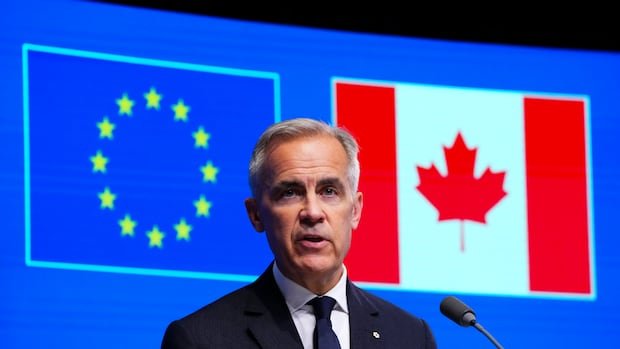
Prime Minister Mark Carney announced on Sunday that Canada is set to engage in talks for a distinctive partnership with the European Union. This decision comes after a report in the Wall Street Journal suggested Canada’s interest in becoming an “associate member” of the EU. Finnish President Alexander Stubb’s remark, as quoted in the article, hinted at the idea of Canada joining the EU as the 28th member rather than being viewed as the 51st state of the U.S.
In response to this news, Conservative Leader Pierre Poilievre and other MPs in his party expressed reservations about Canada potentially becoming the 28th state of the EU. Carney clarified during the Toronto International Film Festival that Canada is not seeking full EU membership but is looking to initiate discussions on a unique alliance with shared values and strengths.
While the idea of full EU membership has circulated in media and among influential figures, including French Foreign Minister Jean-Noël Barrot’s casual suggestion, Carney has consistently maintained that formal membership is not under consideration. Instead, the focus remains on enhancing cooperation for mutual benefits without compromising Canada’s independence.
Regarding the proposed “associate member” status for Canada within the EU, it is emphasized that this title is not legally binding. Canadian officials are exploring various relationship models with the EU and aim to outline clearer details during the EU-Canada summit in October. The objective is to deepen ties that go beyond existing agreements, such as the Comprehensive Economic and Trade Agreement (CETA) and the Strategic Partnership Agreement.
Both Carney and the EU ambassador to Canada, Geneviève Tuts, have highlighted the need for a “unique” partnership, emphasizing the importance of strengthening security and economic collaboration. Discussions are expected to focus on energy, AI, critical minerals, and defense cooperation, with a vision to provide more opportunities for Canadians in various aspects.
As discussions progress, experts foresee potential agreements in critical areas such as mineral stockpiling, student exchanges, and digital trade. However, the nature of these agreements may not result in a comprehensive pact but rather a series of strategic collaborations labeled under the broader theme of cooperation. The specifics of this evolving relationship are expected to be further elucidated in upcoming speeches by Carney and European Commission President Ursula von der Leyen.

