

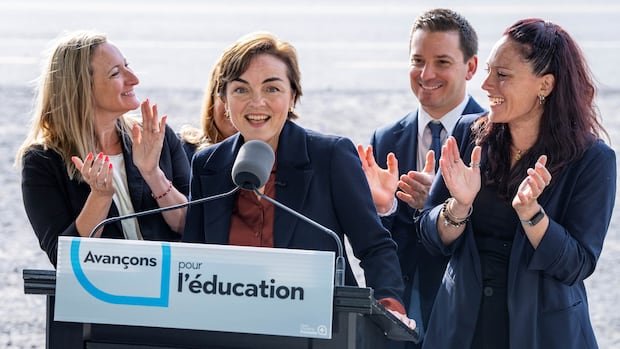
Last week, the leader of the Coalition Avenir Québec, Christine Fréchette, made an education-related announcement in front of a new high school in Saint-Zotique, Quebec. While her pledge to invest $1,000 in every Quebec-born child’s Registered Education Savings Plan (RESP) was noteworthy, her response to a question about Quebec’s three-tier education system garnered attention.
Fréchette downplayed the existence of a three-tier system in Quebec, which encompasses subsidized private schools, public schools with specialized programs, and regular public schools. Her statement followed a recent report from Montreal public health officials that criticized the system for exacerbating health disparities among students in the city.
The study revealed significant disparities between private and public school students, particularly in graduation rates. Students from private schools had a graduation rate of 92.5%, compared to 79.8% for those in the public system. Additionally, students from more advantaged backgrounds had higher graduation rates than their disadvantaged peers.
Dr. Mylène Drouin, head of Montreal Public Health, emphasized that students facing academic challenges and coming from disadvantaged backgrounds bear the brunt of these disparities, impacting their health and educational prospects. The report highlighted various health disparities between public and private school students, including lower self-esteem, higher mental health diagnoses, and less healthy lifestyles among public school students.
Fréchette’s remarks drew criticism from union leaders and Québec Solidaire, who accused her of being out of touch with the reality of Quebec’s education system. Québec Solidaire vowed to eliminate the three-tier system if elected, citing private school subsidies and selective programs as drivers of social segregation.
There have been calls from various stakeholders, including the Fédération autonome de l’enseignement (FAE) and the CSQ, for a comprehensive consultation on education in Quebec. While some parties have pledged to launch such consultations, the CAQ has opposed the idea, citing potential delays in necessary reforms.
Amidst this debate, the province’s federation of private schools launched a campaign emphasizing the complementary nature of private and public education systems. The campaign aims to debunk myths surrounding private school funding and selection criteria, highlighting the role of private schools in accommodating students with special needs.
The ongoing discussion underscores the need for broader reflection on Quebec’s education system to address social inequalities and ensure equal opportunities for all students.

