

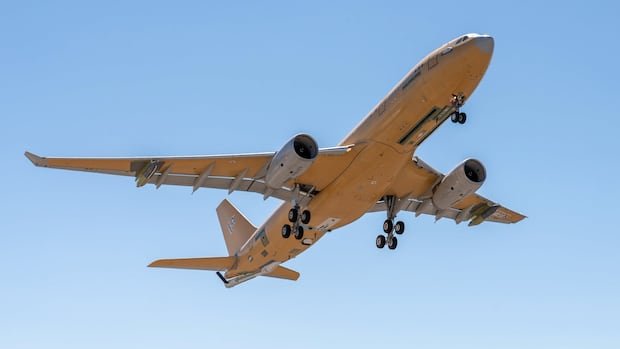
Canada’s air force is set to receive the first of four new air tankers by the end of next year, crucial for refueling fighter jets in the Arctic. The Royal Canadian Air Force (RCAF) has provided details on the CC-330 Husky fleet, replacing aging Airbus 310s, which are vital for long-distance troop transport and official travels.
The primary function of these wide-body jets is to serve as aerial refueling stations, a critical aspect as Canada enhances its continental defense capabilities. The Department of National Defence confirmed that the initial new aircraft will be handed over to the RCAF in late 2027.
In a significant procurement move, Canada acquired nine Airbus A330s in July 2023 for around $3.6 billion, comprising five pre-owned aircraft with minimal service history from Kuwait Airways and four brand-new planes. The department had not previously disclosed the delivery timeline for these new acquisitions.
Presently, three of the pre-owned Airbus planes have arrived in their original commercial configuration. While these planes are currently used for passenger transport, including the prime minister, one has entered scheduled maintenance, and another is undergoing refurbishment in Switzerland to be converted into an air tanker.
The first newly constructed air tanker is undergoing testing in Spain, with the other three in production in Toulouse, France. These air tankers are essential for supporting the RCAF’s CF-18 and upcoming F-35 fleets during Arctic patrols and other missions requiring extended flight durations.
The new tankers will feature advanced refueling capabilities compatible with all NATO aircraft, addressing the limitations of the previous aircraft, which lacked the necessary equipment for certain aircraft types.
Moreover, the new V-VIP Airbus being refurbished in Switzerland for the prime minister will be equipped with a “self-protection suite” to defend against potential missile threats, utilizing advanced defense mechanisms such as lasers, flares, and countermeasure systems.
The RCAF expects to achieve initial operational capability for the CC-330 Husky fleet by 2028-29, with full operational readiness for all nine jets by 2032-33. The air force is currently based in Ottawa, with plans for new facilities under development in Trenton, Ont., and Edmonton.
As the RCAF transitions to the new air tankers, the existing fleet of Airbus A310s, known as the CC-150 Polaris, will remain in service until 2030. These older aircraft, originally operated as Wardair passenger jets in the late 1980s, have served various government officials and will continue operations until their retirement.
Additionally, an incident in 2023 involving one of the A310s resulted in a write-off after colliding with another parked plane due to parking brake failure. The investigation highlighted factors such as crew fatigue, inadequate safety measures, and checklist procedures leading to the incident.
With these developments, Canada is strengthening its air force capabilities and modernizing its fleet to meet evolving defense needs and ensure operational readiness for future missions.

