

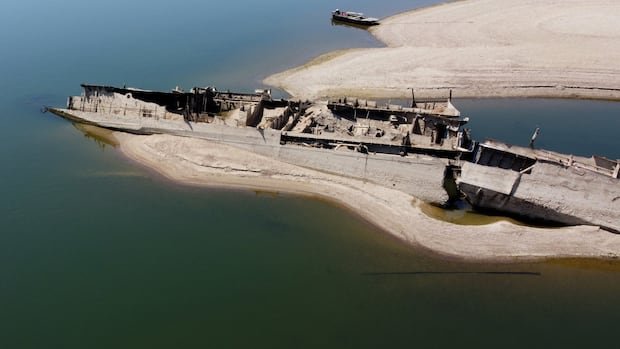
Nazi German warships deliberately sunk in the Danube River during World War II are re-emerging due to the receding water levels caused by the ongoing heatwave and drought in Europe. This marks the fifth heatwave since May, with temperatures in parts of Spain, France, and Italy nearing 40 degrees Celsius. The Copernicus climate monitoring service of the European Union recently confirmed that June and July experienced the highest temperatures ever recorded in western Europe, leading to an estimated 25,000 heat-related deaths.
The extreme heat has triggered devastating wildfires and led to historically low water levels in crucial waterways like the Danube. Climate experts warn that these resurfacing warships serve as a stark reminder of the broader issue at hand: the accelerating impact of climate change fueled by fossil fuel emissions, intensifying heatwaves, droughts, and their repercussions on various sectors such as agriculture, transportation, and energy infrastructure across Europe.
According to historians, the Nazis scuttled around 200 warships near the Serbian city of Prahovo in September 1944 to halt the advancing Soviet forces. Unusually low water levels in the Danube have also revealed other artifacts such as a German military motorcycle in Hungary, an unexploded British bomb in Slovakia, and what is believed to be ancient mammoth remains in Bulgaria. These discoveries underscore the critical water scarcity concerns facing multiple countries along the Danube, Europe’s second-longest river.
Recent temperature data shows a significant increase in average surface air temperatures across Europe compared to historical averages. The rise in temperatures is a clear indication of the compounding effects of heatwaves and droughts exacerbated by climate change, as highlighted by climate experts. The drying Danube serves as a distressing signal of the worsening environmental conditions, with potential far-reaching consequences for ecosystems and communities.
Governments in affected regions have been forced to implement stringent measures to mitigate the impact of the water crisis on vital sectors like agriculture and energy production. The situation underscores the urgent need for sustainable resource management and climate action to safeguard natural resources and combat the escalating effects of global warming. Experts warn that without immediate intervention to reduce greenhouse gas emissions, the current challenges posed by climate change are just the beginning of a potentially more severe future scenario.

