

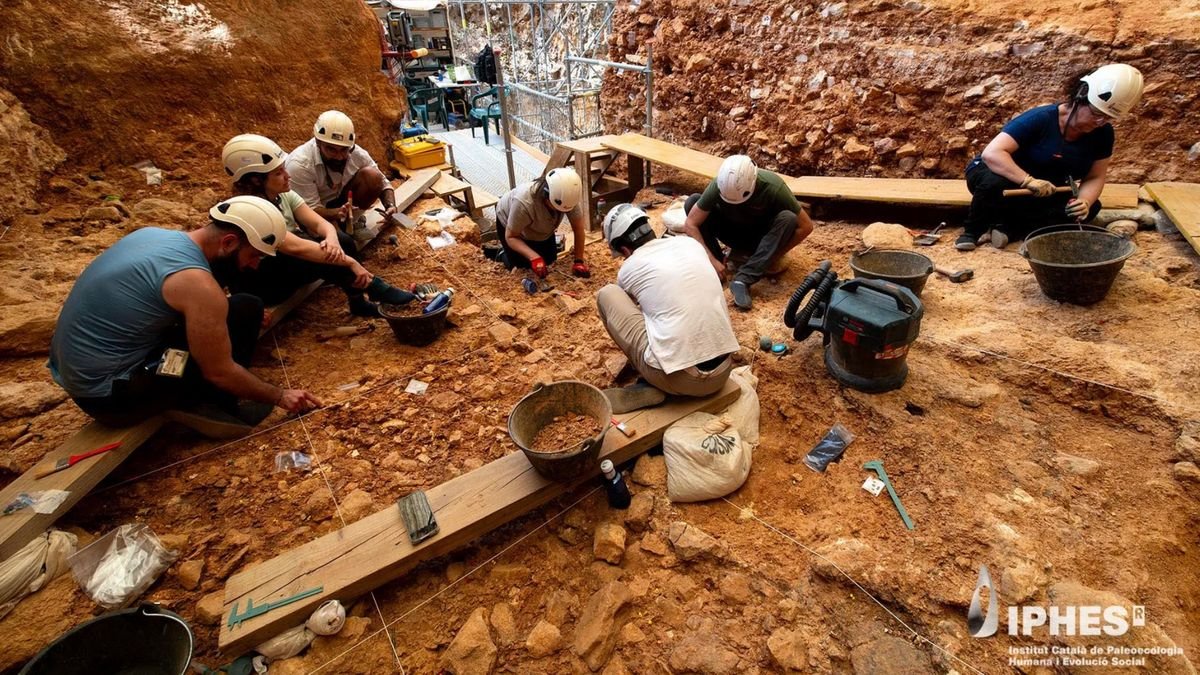
New findings from cave fossils shed light on the unsettling behaviors of a remote human ancestor, revealing evidence of cannibalism within their own communities involving both adults and children. Researchers from the Catalan Institute of Human Paleoecology and Social Evolution (IPHES) made these discoveries while exploring the Gran Dolina cave at the Archaeological Site of Atapuerca in northern Spain’s Burgos region. During a recent excavation, they unearthed two dozen bones and teeth, including skull fragments, spinal bones, arm and leg bones, and three teeth belonging to the extinct human ancestor Homo Antecessor.
According to the institute’s statement, the collection of bones from this Spanish site suggests that a specific group of Antecessor individuals, living between 770,000 and 1.2 million years ago, engaged in cannibalistic practices. Researchers observed distinct cut marks on several bone fragments, indicating that flesh had been removed using primitive stone tools. Previous discoveries at the site, including bone fragments from young children bearing similar marks, along with the new findings on adult remains, suggest that cannibalism was practiced across different age groups within the community.
Further analysis of the bone cluster revealed evidence suggesting that between 13 to 15 individuals inhabited the cave, a larger number than previously estimated. These discoveries provide valuable insights into the daily life and social structure of this ancient hominid species. The researchers revisited the cave’s Aurora layer, where the initial fossils were found in the 1990s, and quickly uncovered the new remains.
Among the notable discoveries was the first ulna bone ever found at the site, along with fragments of a tibia, femur, and humerus. While many of these bones were fragmented, they are expected to contribute to archaeologists’ understanding of the ancient community that resided at the site over 850,000 years ago. The findings build upon previous evidence indicating cannibalistic behaviors among the Antecessor population.
The lead coordinator at IPHES, archaeologist Palmira Saladie, expressed that the recent discoveries mark a significant milestone in the team’s study of the site, offering a more comprehensive view of the ancient population’s biology, demographics, and behaviors. The presence of adult individuals with cut marks challenges previous assumptions that cannibalism was limited to younger members of the group.
In addition to human remains, the excavation also unearthed a variety of stone tools crafted from flint, quartz, and sandstone. Bones from different animal species such as hyenas, deer, beavers, horses, and rhinos were also discovered at the Gran Dolina site. These findings contribute to a deeper understanding of the environment and activities of the ancient community that once inhabited the cave.

