
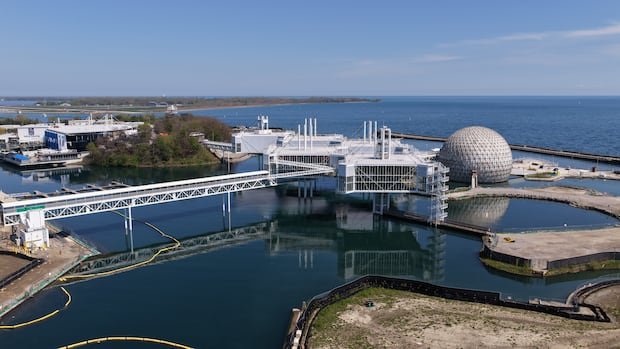
The Supreme Court of Canada is set to review arguments on Thursday from a coalition challenging the constitutionality of a law facilitating significant changes at Ontario Place. The case, unfolding in Canada’s highest court, could have wide-reaching implications beyond the Toronto waterfront park established in 1971. Ontario Place, over the years, has been home to various attractions like a spherical theater, children’s play areas, a rotating concert stage, and pavilions suspended above water.
The Ontario government aims to redevelop Ontario Place to include a spa managed by a private company, a relocated Ontario Science Centre, upgraded play and shoreline spaces, a parking structure, and a provincial police detachment. The Ontario Place Protectors coalition contested the province’s Rebuilding Ontario Place Act (ROPA), arguing that it shields governmental actions from judicial review, thus contravening the Constitution. They also claimed that exemptions from environmental and heritage laws and municipal noise regulations breach public trust.
An Ontario judge dismissed the coalition’s application in 2024, a decision upheld by the provincial Court of Appeal. Justice Grant Huscroft, writing on behalf of the Court of Appeal, emphasized that the court is not a platform for addressing political disputes, stating that the focus should be on whether the ROPA provisions violate the law or Constitution, which he concluded they do not. In January, the Supreme Court agreed to hear the Ontario Place Protectors’ case.
The coalition argues that superior courts historically have the authority to review laws and government actions under section 96 of the Constitution Act, 1867, and provide remedies when the government oversteps its powers. They assert that the ROPA infringes on section 96 by limiting the courts’ core powers. The coalition also seeks recognition of the public trust doctrine as a constitutional principle inherited by Canada.
Margie Zeidler, a member of the Ontario Place Protectors coalition, highlighted the significance of the fight beyond the theme park, questioning the democratic principles at play. The Crown and the Ontario attorney general have called for the case’s dismissal, contending that the legislation does not create a lawless environment at Ontario Place.
The case has garnered interest from various interveners, including provinces, First Nations, civil liberties groups, and environmental organizations. The Supreme Court typically delays decisions, indicating that a ruling may not occur until the following year.

