

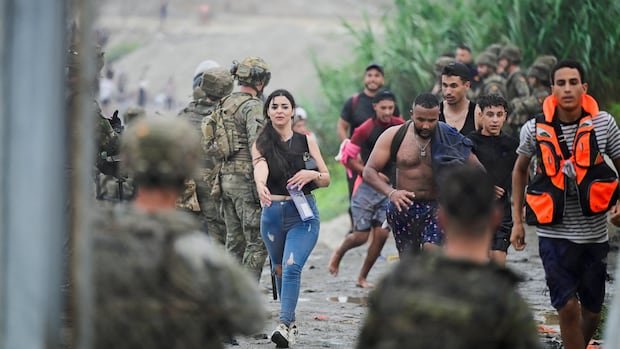
Spain and Morocco have strengthened the border fence of a Spanish enclave, effectively reducing mass crossings after tens of thousands of individuals arrived by sea and land in a single day. According to officials, the influx led to the tragic deaths of at least 57 people, with around 60,000 individuals crossing into Ceuta in recent days.
By 6 p.m. local time on Friday, approximately 48,300 migrants had voluntarily returned to Morocco as reported by Spain’s Interior Ministry. The sudden surge of migrants into Ceuta, a small Spanish territory protruding into the Mediterranean from Morocco, caused consternation and discord in Europe. France announced heightened border checks with Spain, while Italy threatened to suspend Spain from the European Union’s internal open border scheme.
Moroccan authorities at the gates of Ceuta utilized water cannon trucks, batons, and tear gas to deter additional crossings. Clashes resulted in the charred remnants of a bus and seven cars nearby. Despite a court ruling imposing constraints on special “border rejection” regulations allowing immediate expulsions from the enclave, Spanish authorities vowed to swiftly expel those who entered illegally.
Spanish Prime Minister Pedro Sanchez condemned the mass crossings as a violation of Spain’s territorial sovereignty and urged Morocco to intensify efforts to stem the flow of people. Ceuta and Melilla, both Spanish autonomous cities in northern Morocco, represent the European Union’s sole land borders with Africa. The two cities, each home to approximately 85,000 residents, periodically witness surges in migrant attempts to reach Europe, but the scale of the recent influx was unprecedented.
Various factors contributed to the surge, including a recent ruling by Spain’s Supreme Court prohibiting the summary return of migrants intercepted at sea while trying to reach Ceuta or Melilla under special rules. Migrants often swim from the Moroccan towns of Fnideq or Belyounech to reach Ceuta, covering distances of approximately five kilometers or less.
Despite reinforced security measures on the Moroccan side of the border, thousands of migrants attempted to breach the border. Some groups sought alternative routes around the fence, while others prepared to swim across. The lack of sufficient policing during the Thursday surge hindered efforts to prevent the crossings, according to Spain’s Guardia Civil police association AUGC.
Migration remains a contentious issue in Europe, particularly in light of the recent surge. European countries are responding with increased border security measures. Notably, German Chancellor Friedrich Merz expressed support for Spain’s stance against illegal migration onto the European mainland. Italy’s Prime Minister Giorgia Meloni indicated readiness to take extraordinary measures to defend borders, including suspending the Schengen Area with Spain.
President Donald Trump of the United States labeled the Ceuta crossings as an “invasion,” emphasizing the need for stricter border controls. While Spain’s Socialist government maintains a firm stance on illegal crossings, it acknowledges the economic contributions of immigrants and has offered a mass amnesty program leading to hundreds of thousands seeking citizenship in the past year.
Tensions escalated as Italy’s Foreign Minister Antonio Tajani criticized Spain’s decision to grant citizenship to irregular immigrants, leading to a diplomatic exchange with Spain’s Foreign Minister Jose Manuel Albares. Albares called for solidarity over partisan politics, emphasizing the need for cooperation among European partners.

