
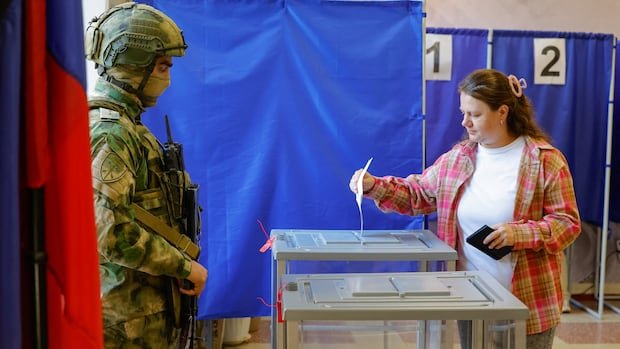
Russians commenced a three-day voting period on Friday in Russia’s initial parliamentary election during wartime. The election, almost devoid of opposition, is expected to solidify the Kremlin’s political supremacy. In an effort to enhance voter turnout among the 111 million eligible voters, authorities extended the voting period over the weekend and introduced electronic balloting. Polls opened on Friday and are scheduled to close on Sunday.
The Kremlin aims for the parliamentary election, the first since the commencement of the full-scale invasion of Ukraine in 2022, to demonstrate public backing for the war and lend a semblance of legitimacy to its actions. President Vladimir Putin, in a pre-election address to the nation, emphasized the significance of citizens’ choices in showcasing solidarity with the armed forces and unity as a nation bound by common values and love for the country.
United Russia, the primary Kremlin-backed party, is poised to maintain its dominant control of the State Duma, the lower house of parliament. Other smaller parties aligned with the government on major issues, known as the “systemic opposition,” are also expected to retain their positions.
The liberal Yabloko party, the sole registered political group that openly criticized the war, was disqualified from the ballot by Russia’s Supreme Court last month. Consequently, the party has only a limited number of candidates competing in the single-constituency races. Additionally, certain anti-war figures have either been incarcerated or compelled to flee the country before the election.
The election coincides with a period of heightened tensions, marked by Ukraine’s deployment of long-range drones targeting oil refineries, leading to a widespread fuel shortage. The disruption has further strained the Russian economy, bringing the impacts of the conflict closer to home for millions of citizens.
Notably, the parliamentary election includes residents from four Ukrainian regions annexed by Russia post-invasion, as well as voting in Crimea, the Black Sea territory annexed by Russia in 2014. Ukrainian authorities have condemned the voting in these areas as illegal, cautioning against participation in organizing the balloting, which could carry legal repercussions.
The voting process, involving a mix of party-based and individual candidate selections, reflects the complex political landscape in Russia amid ongoing military actions and international tensions.

