

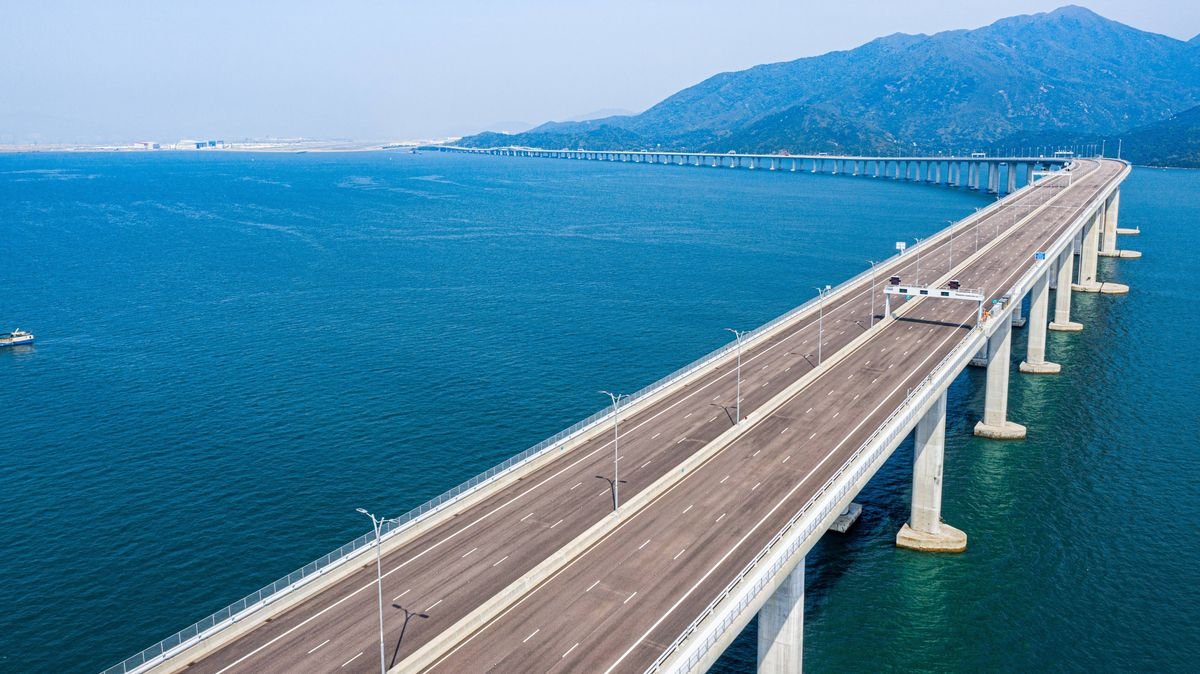
Spanning over the Pearl River Delta for 34 miles, the Hong Kong-Zhuhai-Macau Bridge holds the record as the longest sea crossing globally, connecting the cities of Hong Kong, Zhuhai, and Macau in southern China. The construction of this 55km bridge took nine years and cost approximately £15 billion.
Significantly reducing travel times between the three cities, the bridge transformed the previous hour-long ferry journey into a quick 40-minute drive. It is a part of a larger initiative to enhance transportation links in the Greater Bay Area, a region being developed by Beijing as a major economic center.
By directly linking Hong Kong and Macau with cities in Guangdong province, the bridge aims to boost trade and mobility in the region. Its construction involved various key elements, such as long-span bridges, artificial islands, and connecting roadways.
The primary section includes three navigation channel bridges – Jiuzhou, Jianghai, and Qingzhou – enabling large vessels to navigate through one of China’s busiest maritime zones. Engineers encountered challenges like frequent typhoons and the harsh marine environment during the construction process.
To minimize disruption to water flow and protect local wildlife like the Chinese white dolphin, the bridge features single-column piers anchored into the seabed. The main bridges have cable-supported structures with distinct tower designs to provide a visually appealing appearance from different viewpoints.
The Jiuzhou Bridge maintains its original sail-shaped towers after modifications made during the detailed design phase. Leading engineering consultancy Arup contributed to various aspects of the project, including preliminary design, artificial island construction, and key road and tunnel connections on the Hong Kong and Macau sides.
Adjacent infrastructure, like boundary crossing facilities and connections such as the Tuen Mun-Chek Lap Kok Link, integrates the bridge into the broader transportation network. Since its opening, the bridge has become a crucial component of the region’s transport infrastructure, underscoring China’s ambitious infrastructure aspirations and the growing need for efficient connections between major cities.
Originally planned to open in late 2016, the Hong Kong-Zhuhai-Macau Bridge was officially inaugurated in October 2018 by Chinese President Xi Jinping. Built with 400,000 tonnes of steel, the bridge is designed to withstand earthquakes and typhoons.
Guangdong News reported that as of May 25, the number of northbound trips by single-plate vehicles from Hong Kong and Macau via the bridge surpassed 10 million, with daily traffic averaging around 11,000 trips.

