
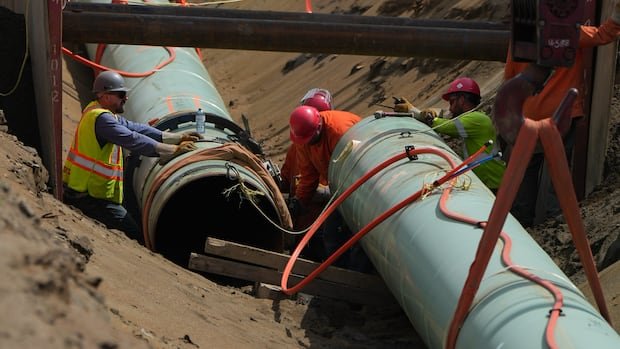
A proposal to construct a pipeline transporting one million barrels of oil daily from Alberta to the British Columbia coast has been identified as the first project of national interest, as announced by the federal and Alberta governments. The inclusion of the West Coast Pacific Link oil pipeline in Schedule One of the Building Canada Act signifies a shift from deliberating on its necessity to expediting the approval process, which includes environmental evaluations.
The decision to streamline the approval process was highlighted by Carney in Fort McMurray, Alberta, emphasizing that this approach provides clarity at the project’s outset rather than its conclusion. It eliminates the need for proponents to invest years and substantial funds before gauging federal support, ultimately fostering growth in the construction sector.
A government official disclosed that the pipeline is projected to enhance Canada’s GDP by up to $30 billion annually, with a significant portion attributed to the pipeline itself. By broadening Canada’s export markets beyond the United States, officials anticipate increased revenue from selling oil at a premium, potentially generating an additional $10 billion annually.
Furthermore, upon approval, the project is forecasted to create around 140,000 jobs, offering a significant economic boost. Minister Dominic LeBlanc has been assigned the task of finalizing the project’s requirements by September 1, 2027, with construction slated to commence and the pipeline anticipated to be operational by 2032-33. The estimated project cost ranges between $35.2 billion to $43.7 billion, inclusive of a contingency fund.
Ownership of the pipeline will be divided among the Alberta government, the federally owned Trans Mountain Corporation, and the Pembina Pipeline Corporation, with Indigenous communities being offered a minimum 10% ownership stake in the venture.

