

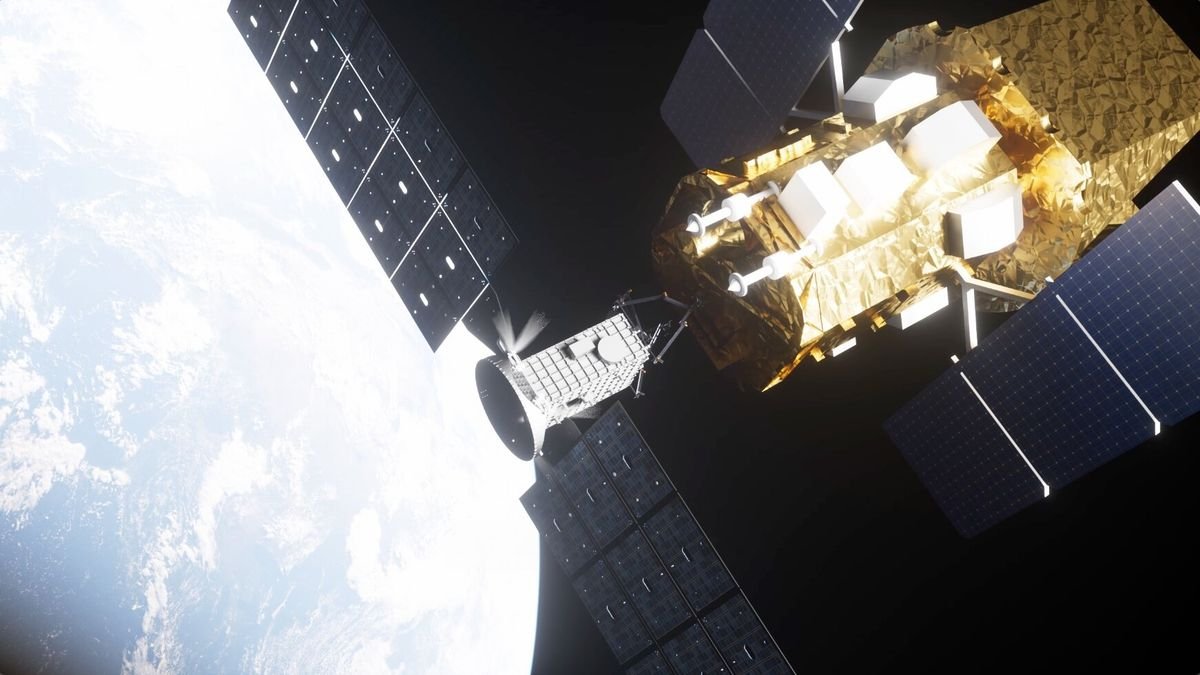
NASA has launched a spacecraft into space with the objective of intercepting a descending telescope before it incinerates during re-entry into Earth’s atmosphere. This daring initiative marks the first attempt of its kind and, if successful, will involve retrieving the car-sized observatory and reinstating it to a secure orbit at a distance of 373 miles.
The Swift observatory is renowned for its capability to identify some of the most intense cosmic explosions from the early stages of the universe. The intricate maneuver of capturing and relocating Swift is being carried out by a spacecraft robot named LINK, comparable in size to a refrigerator and equipped with small thrusters to prevent any harm to the observatory.
The successful interception by the three-armed spacecraft, launched on Friday, could potentially pave the way for rescuing other crucial satellites, including the iconic Hubble Space Telescope, consequently saving substantial amounts of money.
NASA enlisted the services of the private company Katalyst Space Technologies to construct the spacecraft and execute the mission. The CEO of the company, Ghonhee Lee, emphasized the high-risk nature of the mission, highlighting the criticality of preventing Swift from disintegrating in the atmosphere.
Recent heightened solar activity has caused the Earth’s atmosphere to interact with Swift, decelerating its speed and gradually decreasing its orbit. With its descent accelerating over the past two years, Swift now orbits at approximately 220 miles and faces the risk of disintegration in October if left unattended.
Challenges such as adverse weather conditions and technical complications led to multiple last-minute launch delays before the Link spacecraft was eventually dispatched from the Marshall Islands in the Pacific on Friday. Propelled by a Pegasus rocket released from a modified aircraft, the spacecraft is on track to rendezvous with Swift in about a month.
Dr. Simeon Barber, a space scientist at the Open University, expressed optimism about the mission’s potential impact on astronomical research, given Swift’s unique capabilities in studying high-energy phenomena.
Originally launched in 2004 at a cost of £220 million, Swift, equipped with three agile telescopes, was designed to investigate massive cosmic events such as gamma-ray bursts and stellar cataclysms. The rescue operation for Swift has incurred a cost of £22 million for NASA.
Prof. Barber outlined the plan for the LINK spacecraft to gradually elevate Swift’s orbit to a stable altitude, emphasizing a methodical approach to prevent abrupt changes in its trajectory.
The success of this mission sets the stage for future rescue endeavors, potentially extending to the Hubble Space Telescope, a massive satellite comparable in size to a bus.
John Nousek, a professor of astronomy and astrophysics at Penn State University, highlighted the significance of satellite retrieval, offering opportunities for NASA and other entities to enhance, repurpose, or expand spacecraft functionalities at a fraction of the cost of new missions.
Kieran Wilson, vice president of technology at Katalyst Space Technologies, expressed optimism that the Swift Boost mission could revolutionize perceptions about satellite longevity among astronomers.

