

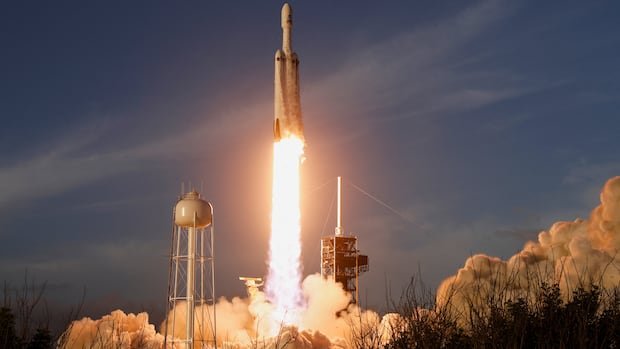
NASA has initiated a new mission to explore key mysteries in astrophysics and cosmology by launching the Nancy Grace Roman Space Telescope, a reconfigured spy satellite aimed at capturing panoramic views of the cosmos. The roughly $4 billion US project was lifted off from NASA’s Kennedy Space Center in Cape Canaveral, Fla., aboard a SpaceX Falcon Heavy rocket on Sunday. The telescope is set to orbit beyond the moon and delve into cosmic puzzles such as dark energy, dark matter, gravitational studies on large scales, and the quest for exoplanets.
Julie McEnery, senior project scientist for the Roman telescope, expressed that the launch marked a milestone for engineers and a new beginning for scientists. The telescope, originally part of a spy satellite program under the National Reconnaissance Office, was repurposed for cosmic exploration by NASA after the program was discontinued in 2012.
Traveling towards Lagrange Point 2, approximately 1.6 million kilometers from Earth, the Roman telescope is named after NASA’s first chief astronomer, often referred to as the “mother of the Hubble Space Telescope.” Over the next 90 days, mission scientists will commission and prepare the telescope for its scientific operations, with the first high-resolution images expected before the winter holidays.
NASA Administrator Jared Isaacman expressed confidence that the Roman telescope, alongside observatories like the James Webb Space Telescope and the Hubble Space Telescope, will become a household name for its groundbreaking discoveries. Roman, possessing similar sensitivity to Hubble but with a quicker survey capability, will offer wide-angle views of the cosmos, complementing the deep observations provided by Webb.
The Roman telescope aims to enhance understanding of dark energy and dark matter by creating a comprehensive 3D map of the universe, covering more than two billion galaxies. By gauging the effects of dark matter and dark energy across the universe, scientists hope to unravel these cosmic enigmas. Additionally, Roman is expected to conduct an extensive search for exoplanets, potentially discovering thousands of new planets and providing insights into planetary systems similar to our own.
Through its mission, Roman is positioned to significantly contribute to astrophysical research and further expand humanity’s knowledge of the universe.

