

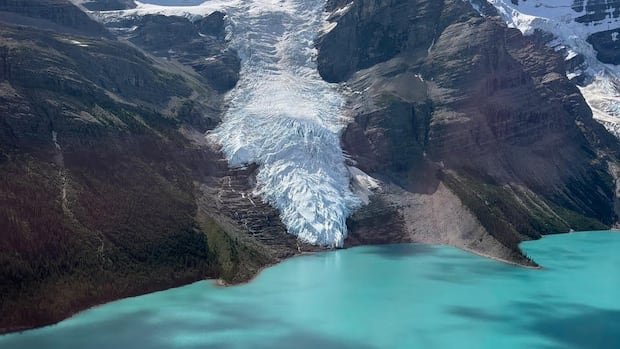
In British Columbia, a significant change has been observed at Mount Robson’s Berg Glacier, where scientists have discovered that the glacier has receded to the point where it no longer reaches Berg Lake. Joseph Shea, a geography associate professor at the University of Northern British Columbia (UNBC), made this observation while leaving a research project on the mountain and captured the moment in a photograph.
Situated on the north face of Mount Robson, the highest peak in the Canadian Rockies near the Alberta border, the Berg Glacier previously extended to Berg Lake, releasing ice chunks into the lake. This natural spectacle, with icebergs floating in the turquoise waters of Berg Lake, has been a popular attraction for outdoor enthusiasts along the 23-kilometer Berg Lake Trail.
Over the past six years, UNBC researcher Brian Menounos and B.C. Parks have been monitoring the changes in the Berg Lake glacier. Recent findings indicate a noticeable separation between the glacier and the lake, signaling a visual representation of climate change.
Menounos’s research on glacier melt has revealed a significant loss in glacier surface area in Western Canada and Switzerland since 1985. The impact of climate change was evident when parts of the Berg Lake Trail suffered severe damage due to melting snow and ice during record-breaking heatwaves in 2021, prompting the evacuation of hikers from the area.
Efforts are underway to mitigate the effects of climate change, with B.C. Parks collaborating with researchers to set up real-time weather stations in Mount Robson Provincial Park. These stations will provide crucial data on snowpack, temperature, humidity, wind speed, atmospheric pressure, and precipitation, aiding park management decisions and enhancing safety measures for visitors.
Despite the glacier’s retreat from Berg Lake, Mount Robson remains a breathtaking destination for visitors, showcasing the enduring beauty of nature amidst the changing landscape influenced by climate change.

