

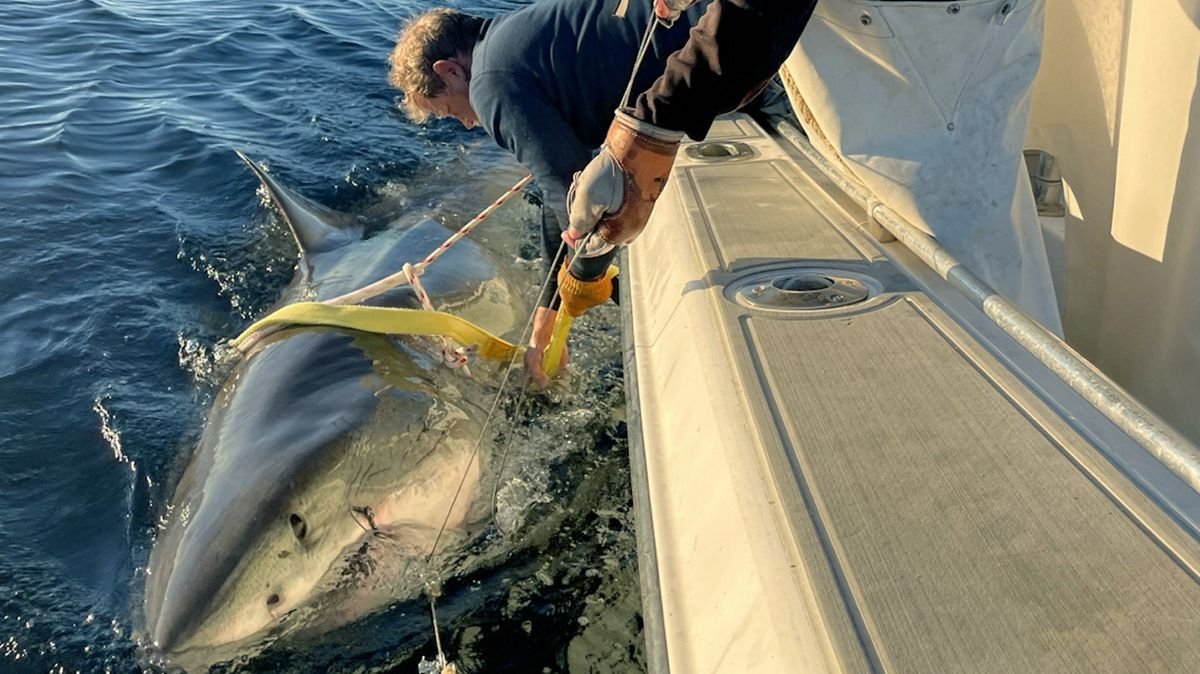
The biggest male great white shark ever recorded in the Atlantic Ocean has been sighted again after disappearing for several months, leading experts to speculate that it might be heading towards popular coastal destinations.
Known as Contender, this massive 14-foot great white shark weighing a remarkable 750kg went off the radar from satellite tracking since its last detection off the Outer Banks of North Carolina in April. However, recent signals from the shark’s tracking tag have reignited curiosity about its next appearance.
Initially tagged by the research group OCEARCH around 45 miles off the Georgia and Florida coast in January 2025, Contender has covered over 7,000 miles along the eastern coastline of North America. Although the latest detection on June 7 was a weak “Z-ping”, indicating the tracking device was not above the water’s surface long enough for an exact location.
Experts speculate that Contender might be on its way for seasonal migration towards Cape Cod or Atlantic Canada, both popular spots for seaside activities.
According to an OCEARCH spokesperson, white sharks in the western North Atlantic typically migrate north during summer and early fall to forage in the waters of Cape Cod or Atlantic Canada, offering suitable water temperatures and abundant food supply, particularly seals and large fish species.
The organization noted that the shark’s fin-mounted tracking tag only transmits a location when it momentarily breaks the water’s surface. The recent Z-ping was described as a weak non-locational ping, typically occurring when the tag briefly surfaces, sending a single message to an overhead Argos satellite.
Having traveled more than 7,000 miles since tagging, the 1,700lb predator has been tracked from Florida waters to the Gulf of St Lawrence in Canada.
OCEARCH previously highlighted Contender as the largest male great white shark ever tagged in the Atlantic. Its movements have shown a shift towards deeper waters in the Atlantic, raising the possibility of breeding, though it could also be foraging in these depths.
Senior data scientist, John Tyminski, mentioned, “This sudden movement could be to forage in deeper waters, but we cannot rule out the possibility that it’s related to reproduction at this time of year.”
Great white sharks have roamed the world’s oceans for over 400 million years, and OCEARCH aims to gain insights into their behaviors, migrations, and potential breeding areas through tracking, providing valuable information for conservation efforts.
Researchers anticipate that tracking Contender’s movements will enhance their understanding of great white shark migration patterns, behavior, and potential breeding habits.

