
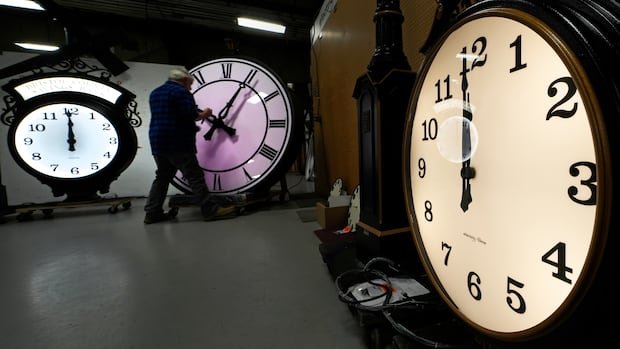
For over half a century, mankind has utilized “leap seconds” to maintain synchronization between our timepieces and the Earth’s rotation. On Thursday, an international organization in France is anticipated to abolish leap seconds, allowing the clocks to gradually fall out of sync by a full hour, a process that could span centuries or even millennia.
The accurate atomic time, established in the 1950s through monitoring the natural vibrations of atoms, slightly deviates from solar time, which derives from the sun’s position in relation to a specific Earth location due to the gradual deceleration of the planet’s rotation. The introduction of the leap second in 1972 aimed to rectify this discrepancy by immediately adding ten seconds, as noted by Scott Beattie, head of the frequency and time team at the National Research Council of Canada’s Metrology Research Centre.
Since then, the International Earth Rotation and Reference Systems Service has been monitoring the difference between solar and atomic time to determine when an extra second is necessary. The International Bureau of Weights and Measures then inserts a leap second either at the end of December or June. Leap seconds have been inserted 27 times, with the most recent adjustment occurring in 2016.
Failure to make these minor corrections would not cause noticeable changes within our lifetimes. However, Beattie warns of a potential scenario where daylight might peak at midnight and darkness at noon in the distant future. This concept mirrors leap years, which add a day to February every four years to maintain alignment between the Gregorian calendar and the seasons, given the Earth’s orbit around the sun takes approximately 365¼ days.
The decision to phase out leap seconds stems from the increasing challenges they pose to modern systems reliant on precise timekeeping. Beattie emphasizes the consensus to eliminate these abrupt adjustments due to their disruptive nature for technology and telecommunications sectors. Various companies implement leap seconds differently, risking network inconsistencies and potential system failures.
Recent years have seen the Earth’s rotation accelerate, hinting at the potential need for a “negative leap second” in the future. This shift has raised concerns within the tech industry, with Meta warning of the detrimental impact such adjustments could have on software. Proposed solutions suggest allowing leap seconds to accumulate to an hour before adjusting clocks, a strategy slated for implementation in May 2027.
While some experts question the efficacy of this approach, others like Samantha Lawler, an astronomy professor at the University of Regina, acknowledge the complexities of Earth’s rotation trends influenced by multiple factors, including climate change. Lawler underscores the inherent imperfections in timekeeping systems, suggesting that accepting slight inaccuracies is an inevitable aspect of tracking time.

